Build a useful newsletter around reader questions, a worked example, subject-line checks and a practical plan for your first three issues.
A useful newsletter concept connects one reader question with a clear answer and a relevant next step. Plan three distinct issues, then agree the material, ownership and signals you will review.
The newsletter is due. Your draft contains a new offer, three links and an opening about how delighted you are to announce something. Read it as a recipient: what would make you give it a few minutes? A useful newsletter concept answers that question before you choose a platform or arrange photographs. This guide builds one from a reader's decision to a complete issue, using an imaginary ceramics studio. The examples are planning exercises, rather than claims about a real client or campaign.
Give the inbox a reason
A newsletter concept defines who you write for, which recurring question you help with and what someone can do after reading. Company updates describe what the sender wants to share. A reader needs a more specific reason to subscribe. Our ceramics studio writes for people choosing handmade tableware who are uncertain about size, glazes and everyday care. Its promise is a practical monthly decision guide, with a relevant glimpse of the making process.
Write your own promise: we help [people] with [recurring decision] by providing [specific help]. If the sentence includes your entire range and company history, narrow it. A clear promise also makes the signup more informative: people can judge whether the content suits them. The monthly rhythm is a working choice for this example, rather than an ideal frequency for every business. Your available material and readers' expectations should inform the actual schedule.
Find the question behind the topic
Our new cups is a subject. Which cup fits under my espresso machine is a question with a useful answer. Collect questions from real enquiries, conversations, feedback and your own website search. If you use search data, record its source and period. Looking at Google results can reveal wording and existing answers, but it does not establish search volume without appropriate data. Avoid treating an appealing phrase as proof of demand.
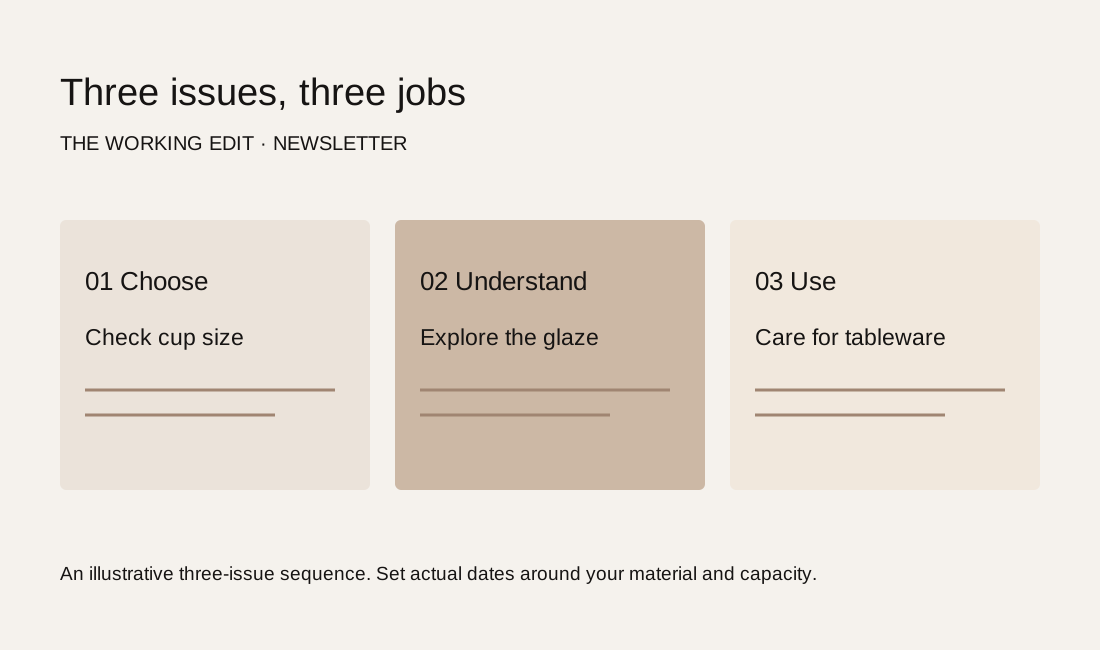
The studio chooses three questions: how do I check the right cup size, what does an uneven glaze mean, and how do I care for handmade tableware? Each supports a different decision. The first helps someone choose, the second explains the craft and the third helps after purchase. This gives three connected issues with distinct jobs. It also makes it easier to decide which photographs and product information each issue needs.
Build one complete issue
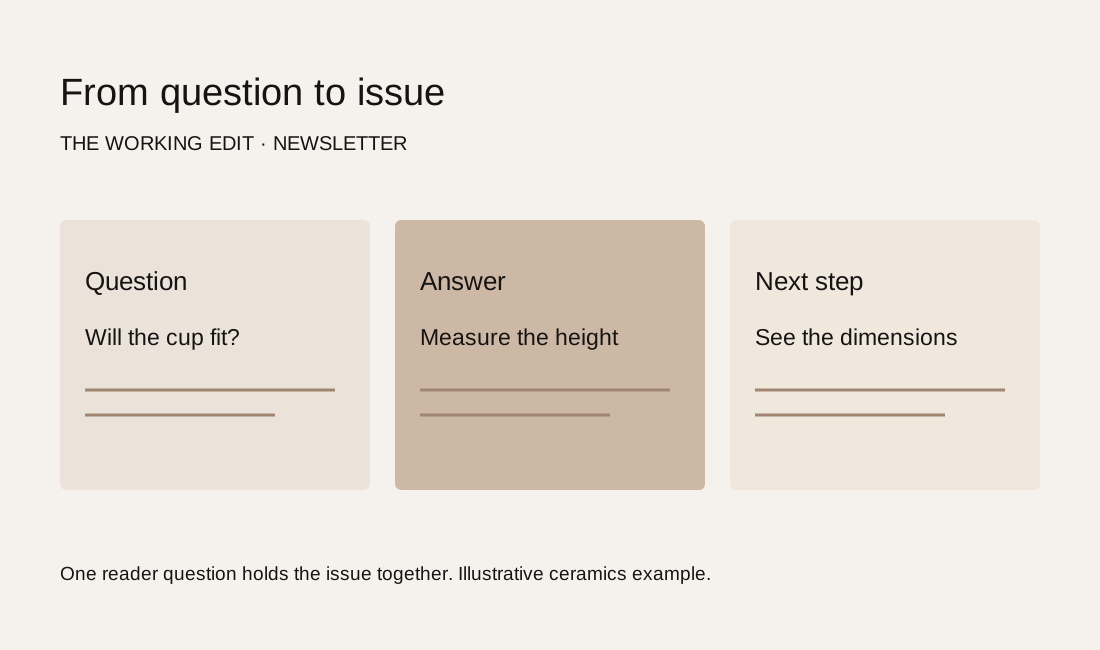
Take the cup-size question. Start with a recognisable situation: the cup looks right, but the space between drip tray and spout is tight. Then give a short method: measure the clearance, compare the cup height against verified product dimensions and allow room to move it in and out. A photograph with a meaningful size reference can help. For an actual product, check the dimensions. A convincing AI scene cannot establish a physical measurement.
The next step leads to a product page containing those dimensions. A short studio note can then explain why different shapes have different heights. The issue has one thread from question to answer to action. A separate sale, event and team introduction can wait for their own relevant moment. Edit out anything that does not clarify the original decision or help someone take the next step.
- Subject: Will your new cup fit under the machine?
- Preview text: Three measurements to check before you choose.
- Opening: the recognisable situation in two or three sentences.
- Main section: a measuring method using verified product information.
- Image: a useful size comparison with a meaningful reference.
- Action: See the measurements leads directly to the relevant details.
Make the subject earn its click
A subject line should promise what the email delivers. A mysterious announcement can attract curiosity while leaving the reader no closer to choosing a cup. Check your line against three questions: is the subject recognisable, is the benefit specific, and does the opened email fulfil the promise? Use the preview text to add information rather than repeating the same sentence in a slightly different form.
Write two options that differ in one way, such as a question and a direct guide: Check your cup size before you buy. A meaningful comparison needs enough suitable recipients and comparable conditions. With a small list, thoughtful replies may be more useful than declaring a winning subject from a handful of clicks. Use the planner below to write your own pair and identify the destination behind the main action.
Design for the actual email
Your website can make a generous visual statement. An email also needs to work when images are blocked or the reading area is narrow. Keep the main idea in real text and establish an obvious reading order. Give each image a task: compare a shape, explain a step or reveal a detail. Write an alternative text that communicates useful information, and repeat essential facts in the message itself.
Test an issue on a small screen, with enlarged text and without downloaded images. Can someone still understand the answer? Does the action explain where it leads, and can you reach it comfortably? Check that links deliver the promised material. Preview the actual message in email applications relevant to your audience. A polished website mock-up cannot establish how a sent email behaves across those applications.
Plan a rhythm your team can keep
For the first three issues, record the reader's question, available material, owner and approval date. If an issue needs product photographs or missing measurements, include that preparation. A date in the calendar is no reason to send unfinished material. A small plan with someone responsible for each task is easier to use than a long list of attractive subjects with no route to publication.
Record how people subscribe, what they expect to receive and how they can unsubscribe. Before launching, check consent, recipients, privacy and technical configuration for your actual situation. This article focuses on editorial planning and design; it is not a complete guide to legal or technical sending requirements. Do not buy an address list for the first issue, and choose test recipients deliberately rather than treating a public draft as a mailing list.
Read the signals, then edit
Before sending, decide what useful behaviour would look like. For the cup guide, it could include visits to the dimensions, relevant questions and replies about the instructions. A click is not a purchase. Privacy features and automated activity can affect open data, so it cannot establish exact human attention. Consider several signals, including unsubscribes and complaints, and record the period behind each observation.
After three issues, ask which questions prompted replies, where destination pages lacked information and which material was difficult to prepare. Use those observations to shape the next three. A newsletter concept is a working editorial agreement that improves through actual experience. Settle what the issue helps someone do first. Choosing a subject line becomes easier once the email has a clear reason to exist.