What does social media marketing involve? Goal, channels, content, community management, ads and measurement explained, plus how to choose between in-house, agency or a mix.

Social media marketing is a set of tasks: goal, channel choice, content, rhythm, community management, advertising and review. Plan around your real capacity, then decide what your team keeps and what you hand over.
Everyone tells you to ‘do more on social media’. But what does that actually mean? A post a week? Reels? Ads? Social media marketing is more than the next item in your feed. It is a set of connected tasks, and you do not have to do all of them yourself. This guide gives you the full picture, so you know where to start and what you might hand over.
What does social media marketing involve?
Whenever we talk to businesses about social media, we end up with the same building blocks. Some are visible straight away; others happen in the background and are easily forgotten. Yet the quiet tasks often decide whether a channel is still alive three months later.
- Goal and audience: what the channel should achieve, and for whom.
- Channel choice: where you start and where you deliberately stay away.
- Content: topics, formats, copy, images and video.
- Rhythm: a content calendar you can genuinely keep.
- Community management: comments, messages and questions.
- Advertising: paid ads as an addition, not a substitute.
- Review: seeing what works and learning from it.
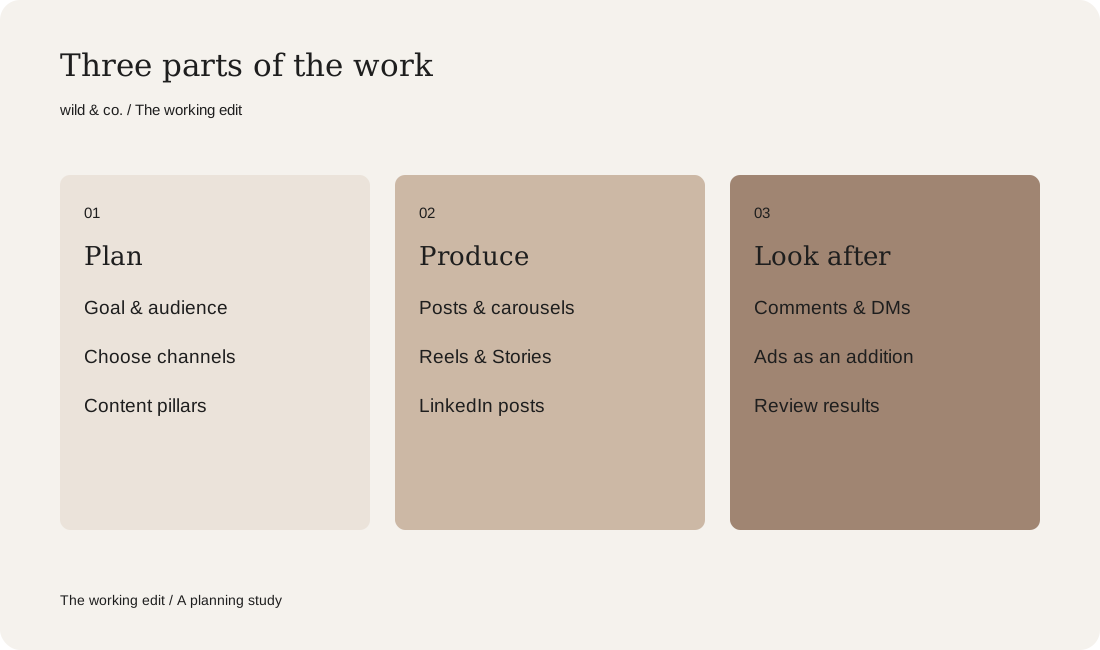
Set your goal, audience and channels
Start with a simple question: what should social media change for your business? More suitable enquiries, applications for open roles, awareness of a new service? One goal is enough to begin with. Next, describe the people you want to reach as precisely as you can. A physiotherapy practice talks to patients differently from the doctors who refer them. Only then choose your channels. Our guide to choosing a platform covers Instagram, LinkedIn and TikTok in detail. The short version: one well-run channel beats three neglected ones.
Your social media split
Content formats: posts, Reels, Stories and LinkedIn
Each format does a different job. A single-image or carousel post explains something calmly and tends to be saved. A Reel shows movement, people and processes, and can reach people who do not follow you yet. Stories are looser: a look behind the scenes, a poll, a nudge towards a new post. On LinkedIn, text, perspective and expertise carry more weight, often from a person rather than a company page. To avoid running dry, settle on a handful of recurring themes, often called content pillars. Our social media strategy guide shows how to build them from your customers' questions.
Production rhythm and community management
The most common mistake is a plan that only works in a quiet week. Be honest about the effort: a Reel needs an idea, a script, filming, editing and publishing, followed by comments and messages. Many teams do well by batching production, for example half a day a month, and scheduling posts afterwards. Decide who replies to comments and direct messages, how quickly you aim to respond and how you handle criticism. Community management is not something to squeeze in between other jobs. It is where people notice whether anyone behind the profile is listening.
Social ads and measurement: what is worth tracking
Paid ads can put content in front of people who do not know you yet. They tend to work better once you know which topics resonate, so start with organic content and use advertising to amplify it. The ad budget sits on top of production costs. Check that music and images may also be used in advertising; the platform terms and your licences are what count here. When reviewing results, reach alone tells you little. Look at saves, shares, messages, profile visits, clicks and, above all, enquiries. And simply ask new clients how they found you.
In-house, agency or a mix?
There is no single right answer, but there are three workable models. Doing everything yourself keeps you close to your audience and saves agency fees, but it takes time, routine and someone who keeps going. Handing everything to a social media agency frees up time and brings an outside view, though you still supply insights, approvals and material. Often a mix fits best. An illustrative example: a café keeps Stories and replies in-house, because that is where daily life happens, and brings in outside help for strategy, Reels and photography.
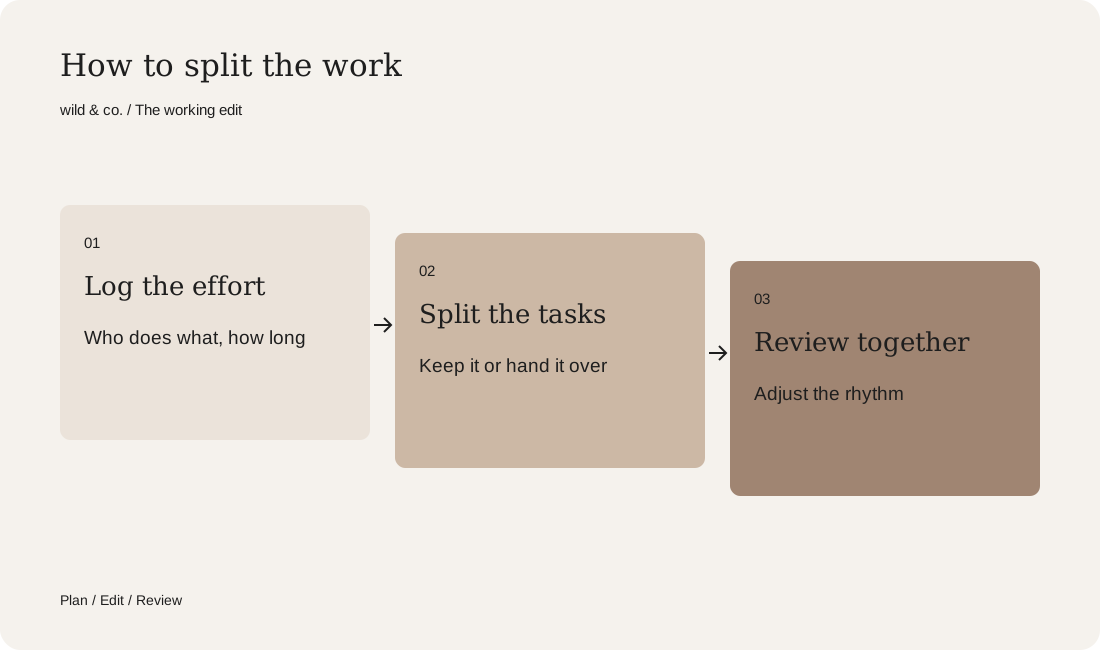
What social media management usually includes
Every agency means something slightly different by social media management, so ask for a written list of what is included. Typical components are:
- Strategy, content pillars and a content calendar.
- Copywriting, post design and templates.
- Photo and video production, including Reels.
- Scheduling and publishing.
- Community management within an agreed scope.
- Regular reporting and adjustments.
- Optional: setting up and running ads.
At wild & co., this is exactly what we work out in a first conversation: what your team wants to keep and where we step in. Before that, note down your goal, your starting channel, the time you realistically have and the tasks you would most like to hand over. With those four points you can compare proposals, or get started properly on your own.