A brief says what needs to happen. An idea decides what people remember. Here is how to get from an insight to a sentence, from the sentence to a concept, and from the concept to images you can test before anything is produced.
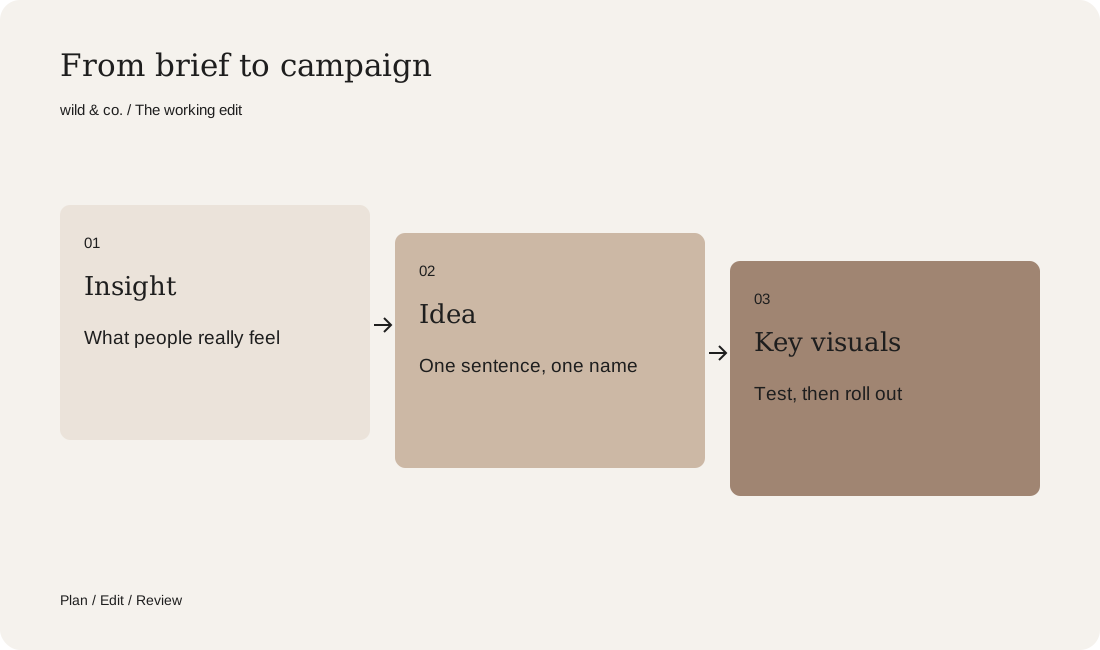
A campaign idea is a thought that generates many executions. It starts with an insight, fits into one sentence and gets a storytelling device, such as a moment or a night rather than a product shot. A name makes decisions easier. Three to five key visuals, often made with AI, let you test the idea before rolling it out across posts, ads, website and newsletter.
The brief is signed off, the product is ready and the launch date is in the diary. Then you sit in front of an empty board and realise that a goal is not an idea. ‘More awareness for the new fragrance’ tells you where to go, but not what people will see, feel and pass on. That gap is where the campaign idea lives. This guide walks through the process step by step, with a worksheet to fill in and an example from our studio.
What a campaign idea is, and what it is not
A campaign idea is not a slogan, not a single beautiful image and not a media plan. It is a thought from which many executions can grow: posts, ads, a landing page, a newsletter, perhaps a poster. One simple test helps. Can you tell the idea in a sentence without describing the product? And can you picture twenty different images that all come from that sentence? If you run dry after three, you probably have a motif rather than an idea.
From brief to insight
The brief provides the facts: product, goal, audience, channels, timing. The idea rarely comes straight out of them, but through a step in between: the insight. An insight is a true, often slightly uncomfortable observation about how people experience something. Not ‘our customers value quality’, but something like ‘you remember a fragrance because of the night you wore it’. A good insight makes you nod and think: that is actually true.
- Listen to how people talk about the subject, in comments, reviews or conversations with your team.
- Look for the moments around the product: when is it used, with whom, and what happens before and after?
- Watch for contradictions between what a category promises and what people actually experience.
- Notice what everyone in your category shows, then ask what happens if you leave exactly that out.
If your brief still has gaps, start there. Our guide to writing a creative brief covers what belongs in it.
Your campaign idea
The idea in one sentence
The insight turns into a sentence that sets a direction. Two formulas help: ‘We are not showing X, we are telling Y.’ Or: ‘What if …?’ The sentence does not need to be elegant. It is a tool for the team. What matters is that it contains a decision, which means it also says what the campaign will not do.
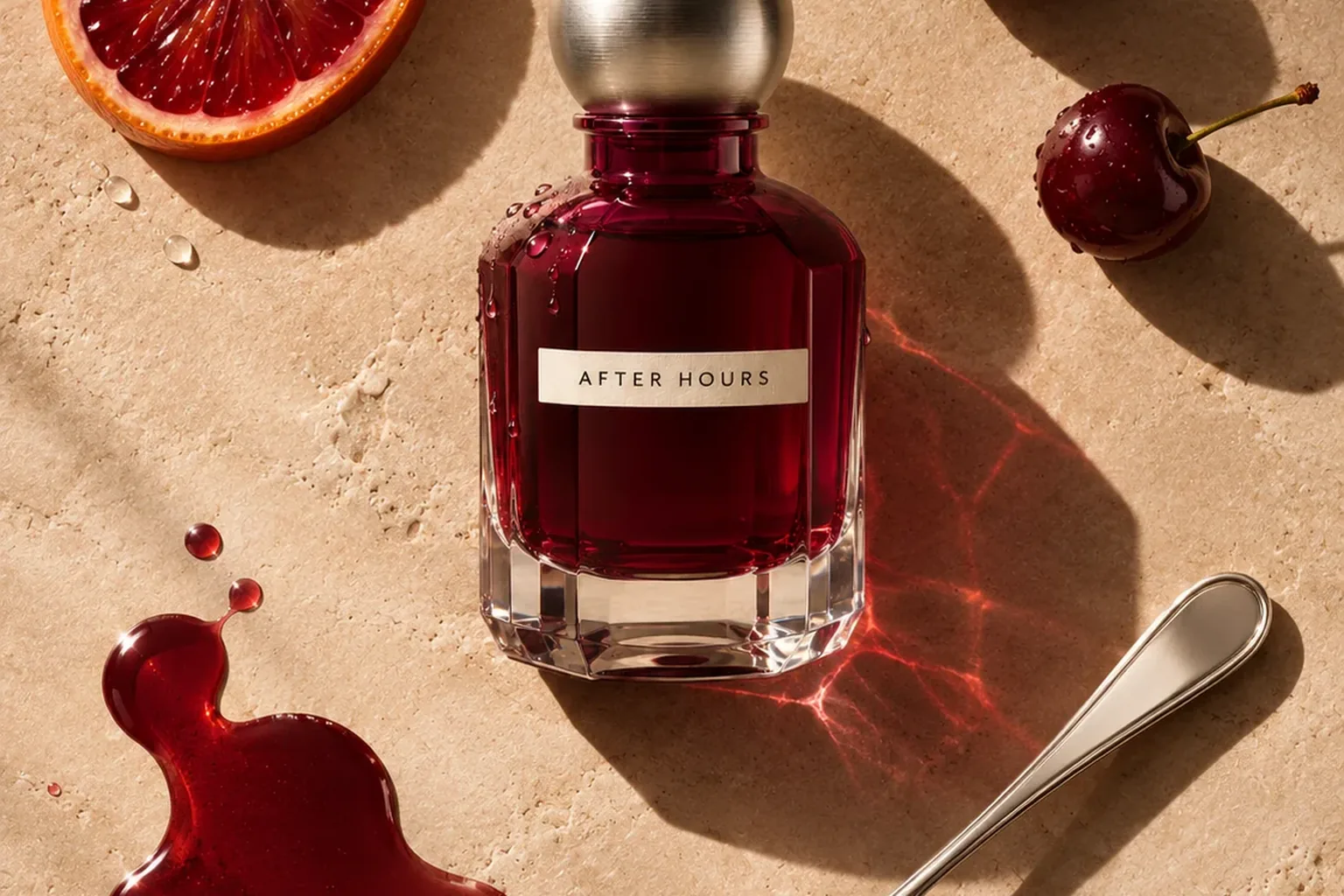
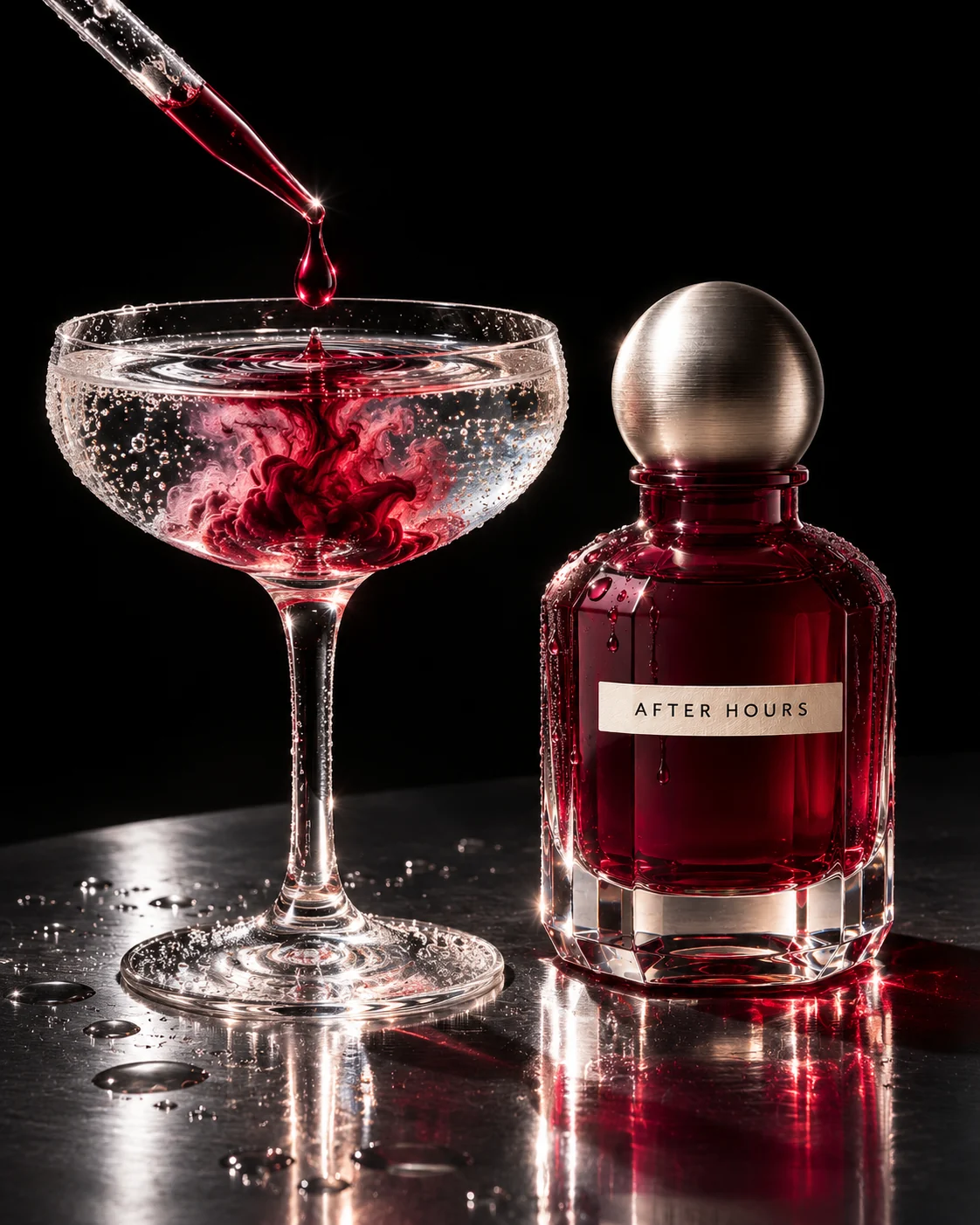
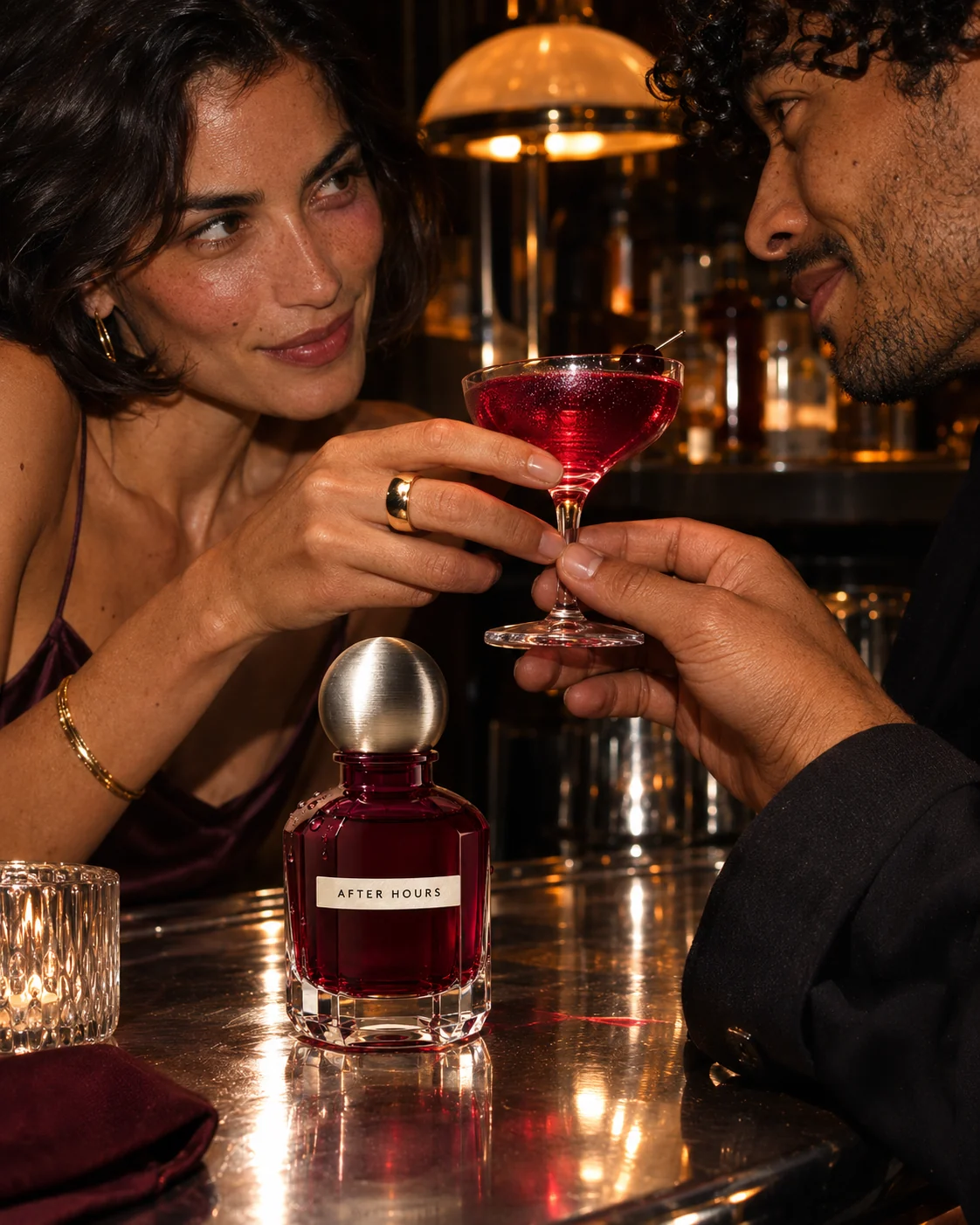
For our independent campaign After Hours we invented a fragrance brand: an eau de parfum in a cherry-red faceted bottle with a brushed steel cap. The brief fitted on a beer mat: ‘a perfume that tastes like last call’. The idea behind it was to stop showing a bottle and tell a night instead.
A concept that can carry many images
A single product shot is quickly made and quickly forgotten. An idea becomes durable once it has a storytelling device that can keep going. For After Hours, that device is the clock. The campaign follows one night from 9 pm to 3 am, and every image is a moment within it, from the first drink to the way home. A second principle sits on top: the scent is written like a cocktail recipe, with blood orange, black cherry and a dash of bitters. Every new image has a place.
Devices like these work for almost any product, not only fragrance:
- Time: a day, a night, a season, a ritual in several steps.
- Place: a room, a street, a route you walk along image by image.
- Recipe or list: ingredients, rules or components shown one at a time.
- Characters: recurring people the audience follows across several images.
- Contrast: before and after, loud and quiet, everyday and exception.
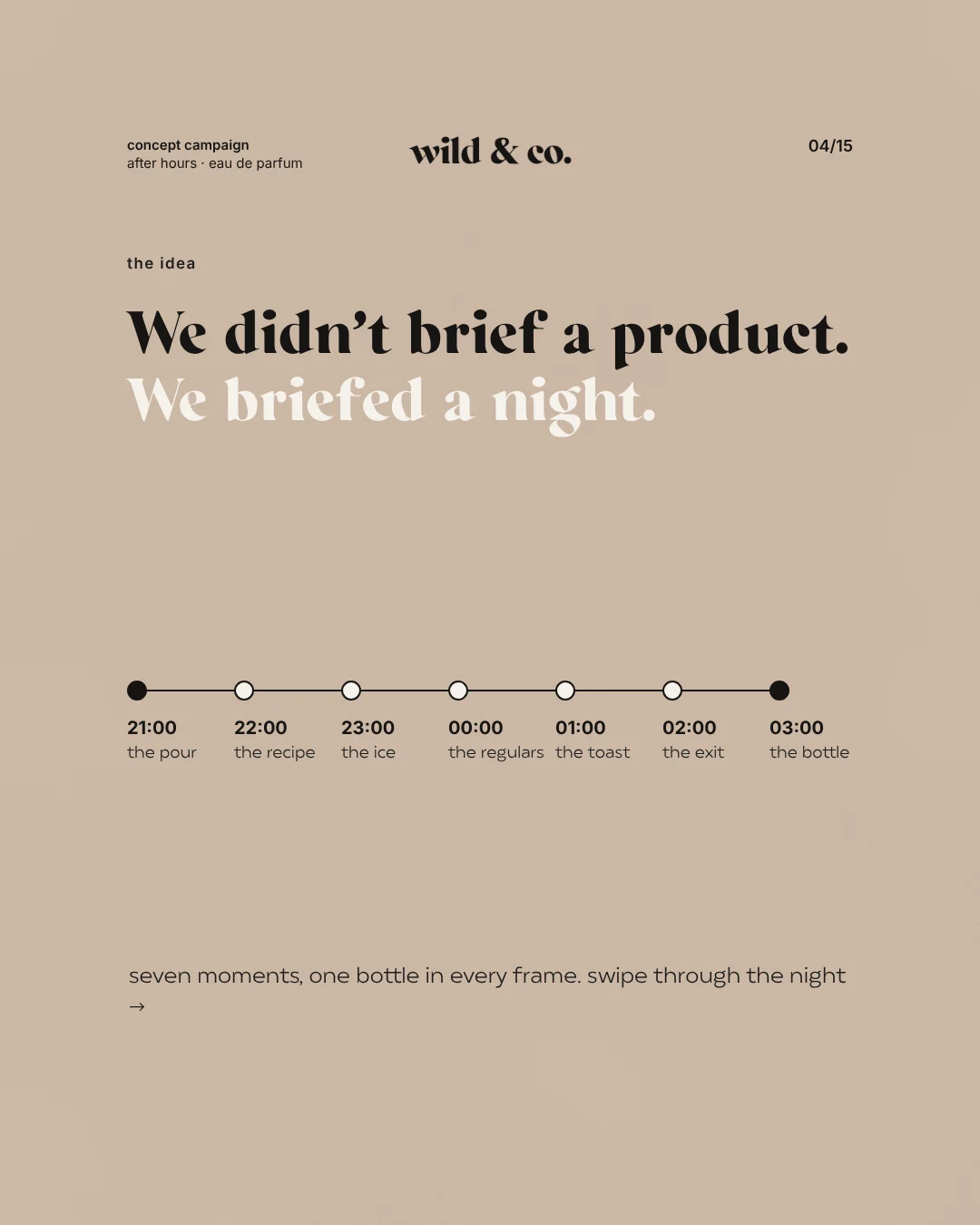
Giving the idea a name
An idea with a name can be discussed. Instead of ‘the version with the dark lighting’, the question becomes ‘does this fit After Hours?’. It sounds trivial, yet it saves many debates, because every image is measured against the idea rather than the taste of whoever is in the room. The name can stay internal or go public. A good working title is short and easy to say, puts a picture in your head and needs no explanation. If it is going to appear publicly, check first whether it is already taken as a trademark, hashtag or account.
Testing with a few key visuals
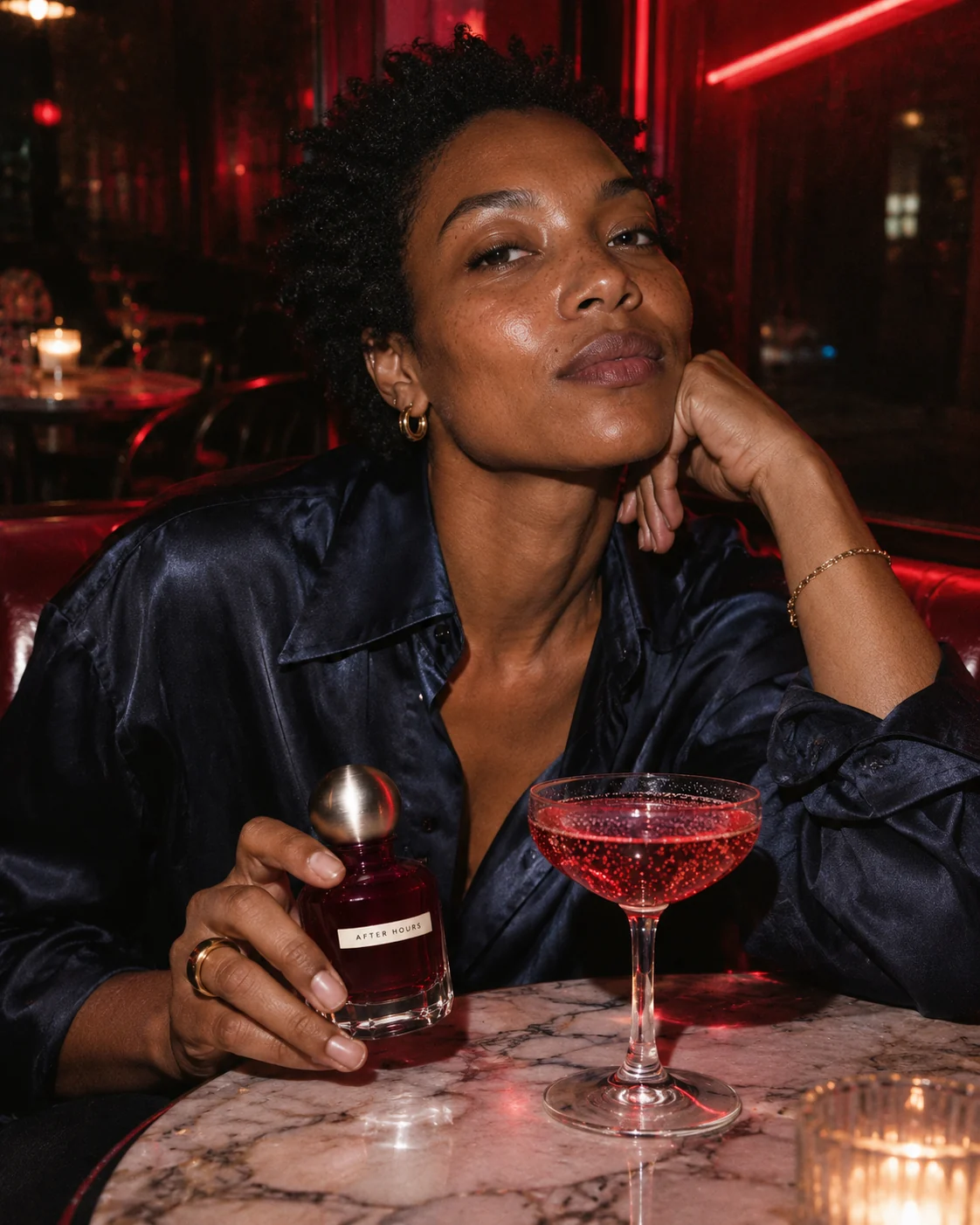
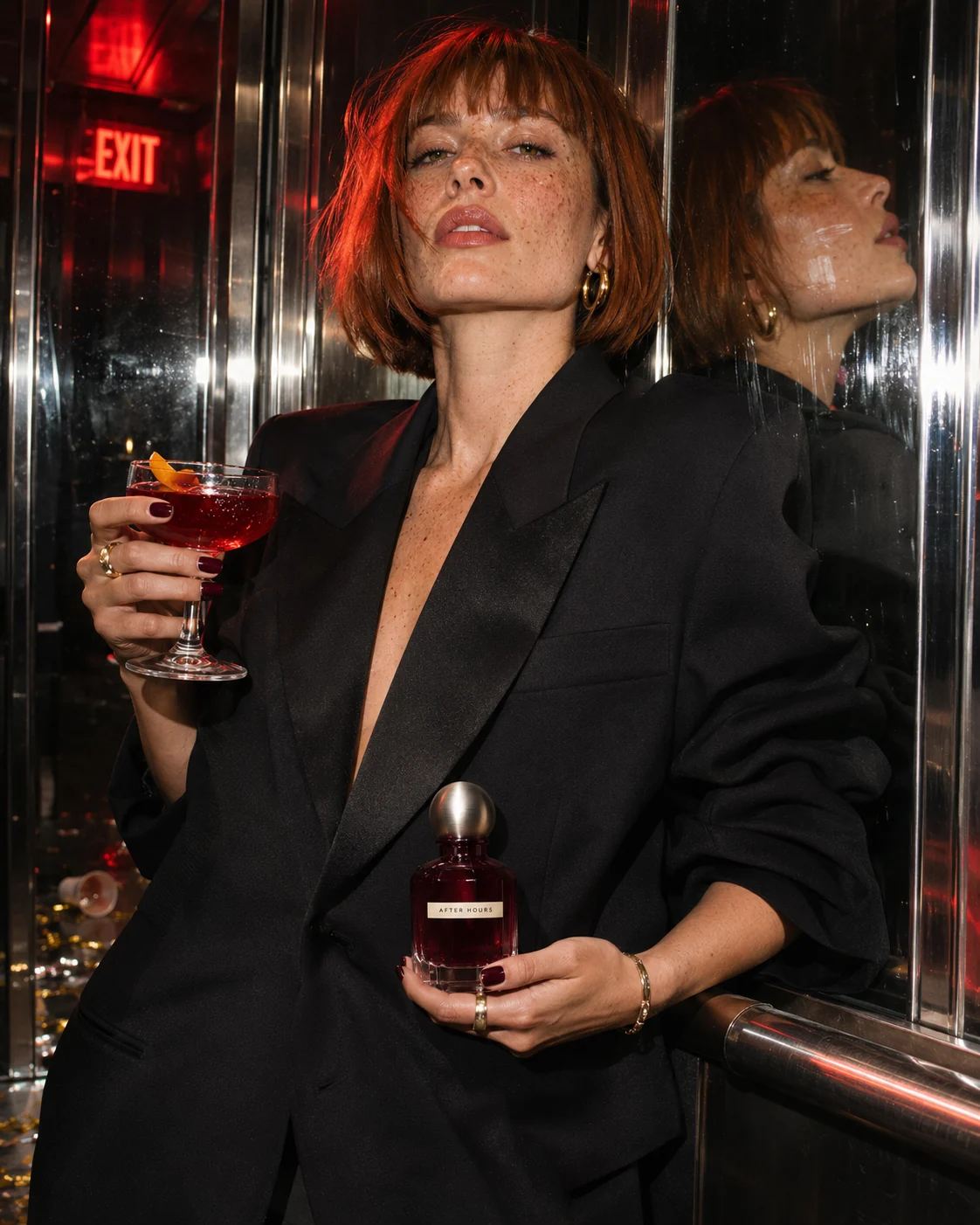
Before forty assets go into production, the idea needs proof. Three to five key visuals are enough to show what the campaign looks like: a product image, a moment with people, a detail, and perhaps a type-only layout with the main line. Put them side by side and show them to people who have not read the brief.
- Is it clear what this is about without an explanation?
- Does it still look like your brand without the logo?
- Can you already picture the twentieth image?
- Does the line work without the picture?
- What would someone tell a friend about it?
For After Hours, the key visuals were three AI models in a bar that never existed, the bottle as the lead character, and one line that holds the whole idea together: ‘People forget a product. They remember a night.’ Every image was made with AI and art-directed by us, and the brand is fictional.
How AI helps you test ideas
Until recently, an idea often stayed a moodboard of other people’s pictures until the shoot. AI lets you see a direction in advance: light, location, casting, colour world, even several ideas side by side. Whatever does not hold up is dropped before a studio is booked or a location arranged.
There are limits. AI visuals are high-resolution sketches, not automatically finished campaign images. Product details such as label, shape and colour have to be checked, or later replaced with real photography. Real people, other brands and their logos have no place in test images, and if AI images are published, say so openly.
Rolling it out: posts, ads, website and newsletter
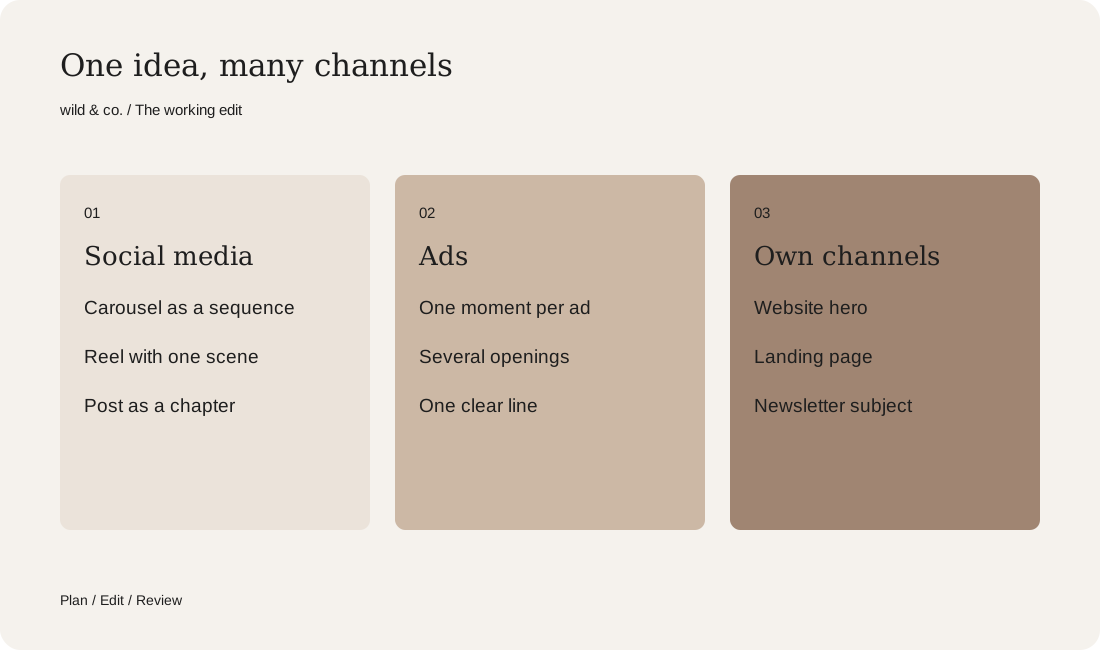
Once the idea is agreed, it is spread across channels. The idea stays the same while the execution adapts. A carousel can tell the whole story, an ad shows a single moment of it, and the website gives the idea room to be read in full.
- Posts and carousels: use the storytelling device, for example one image per hour or one slide per ingredient.
- Ads: one clear moment per ad, plus several openings from the same idea to test against each other.
- Website: hero image and main line, with the fuller story on a landing page.
- Newsletter: take the subject line and opening from the idea, not from the product sheet.
- Plan formats from the start, so no image has to be cropped to pieces afterwards.
Our page on social and Google ads explains how we plan campaigns for paid reach and test variations.
Common pitfalls
- The slogan is mistaken for the idea, and afterwards nobody knows which images belong to it.
- Three ideas run at once because nobody wanted to choose.
- The idea only works in one image and is used up after the launch post.
- A trend replaces the insight and feels dated within weeks.
- The direction changes halfway through because the first numbers make everyone nervous.
Do it yourself or bring in a studio?
You can get a campaign idea started on your own. The worksheet above takes you from the brief through the insight to three key visuals and your channels. An outside view helps when you are too close to the product or want to see the idea before anything is produced. At wild & co. in Zurich we develop campaign ideas, test them with AI key visuals and roll them out across social media, ads, website and newsletter, for brands across Switzerland, in person or remotely.