What spec ads are, why we make independent AI campaigns and how one sentence becomes a full campaign without a shoot. With two examples and the limits worth knowing.
A spec ad is an uncommissioned campaign for an existing or invented brand. With AI it needs no shoot: a one-sentence brief, a defined visual world, a planned sequence of frames and a strict edit. Real logos, patterns and people do not belong in your own advertising.
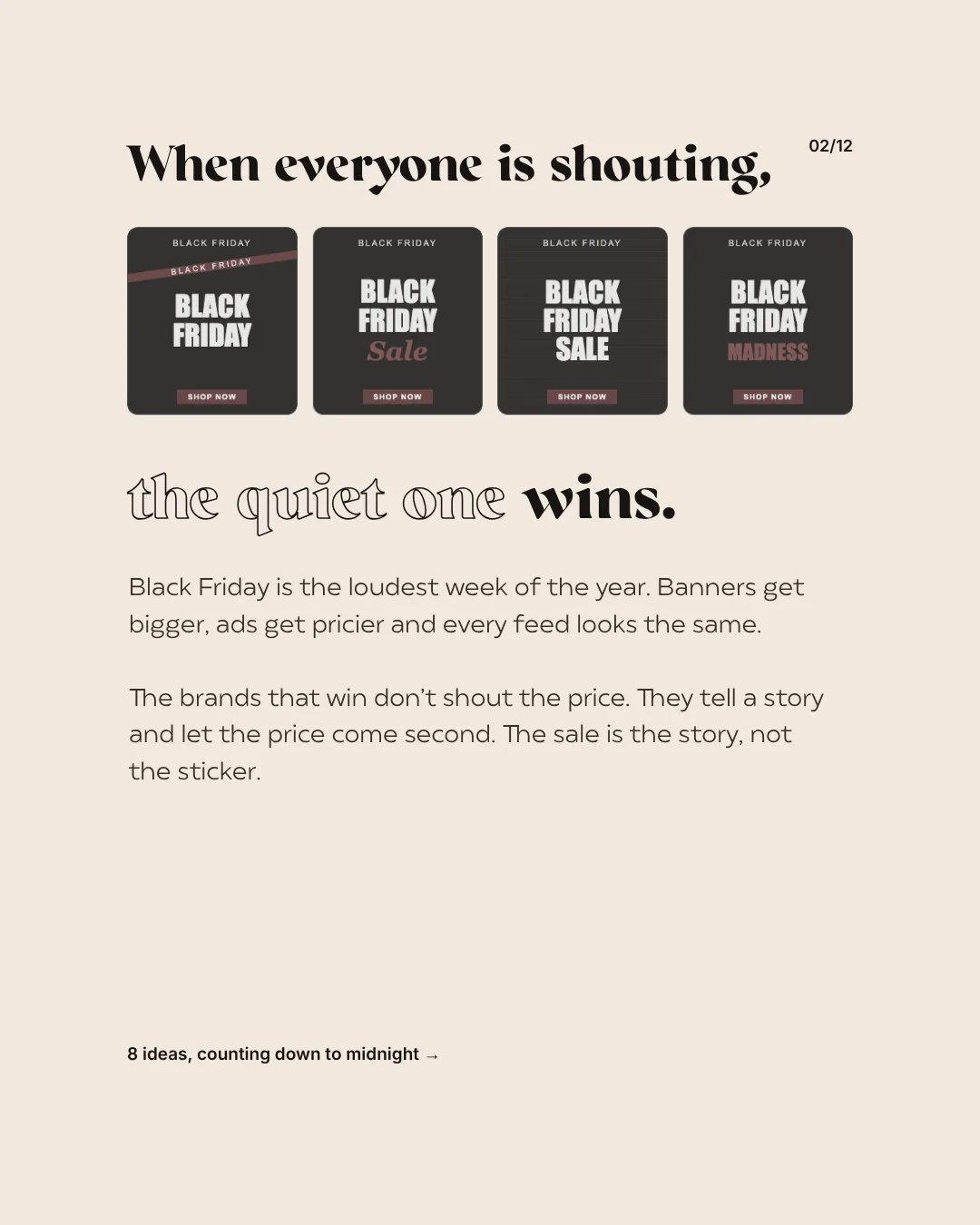
On our Instagram you will regularly find campaigns for brands that have never hired us. A hand wash in a travertine bathhouse. A road trip through Paris with leather goods and a scooter. An eyewear brand that whispers on Black Friday instead of shouting. None of them needed a shoot; all of them were made with AI. In the creative industry this kind of work is called a spec ad. Here is what it means, how we approach it and where the limits are.
What is a spec ad?
Spec stands for speculative. A spec ad is advertising nobody ordered. Creatives use it to show how they would stage a brand. It is best known in film: young directors shoot commercials for cars, fragrances or trainers to recommend themselves for real work. That used to take a camera, a crew and a budget. With AI, a clear idea, a lot of patience and a good eye are enough.
The attitude matters: a spec ad is a study. It does not claim a brand commissioned it, and it does not advertise on the brand's behalf.
Why we make independent AI campaigns
Independent campaigns are both training ground and shop window for us. We try new tools without a client project paying for the learning curve, and we show how we think, including in industries where we do not have a reference yet.
- We test workflows before they reach a client project.
- We train consistency: one face, one product, one light across many images.
- We show clients what AI can do instead of only describing it.
- And honestly, building a world from scratch is simply fun.
Your AI campaign plan
Example 1: a small ritual for a hand wash
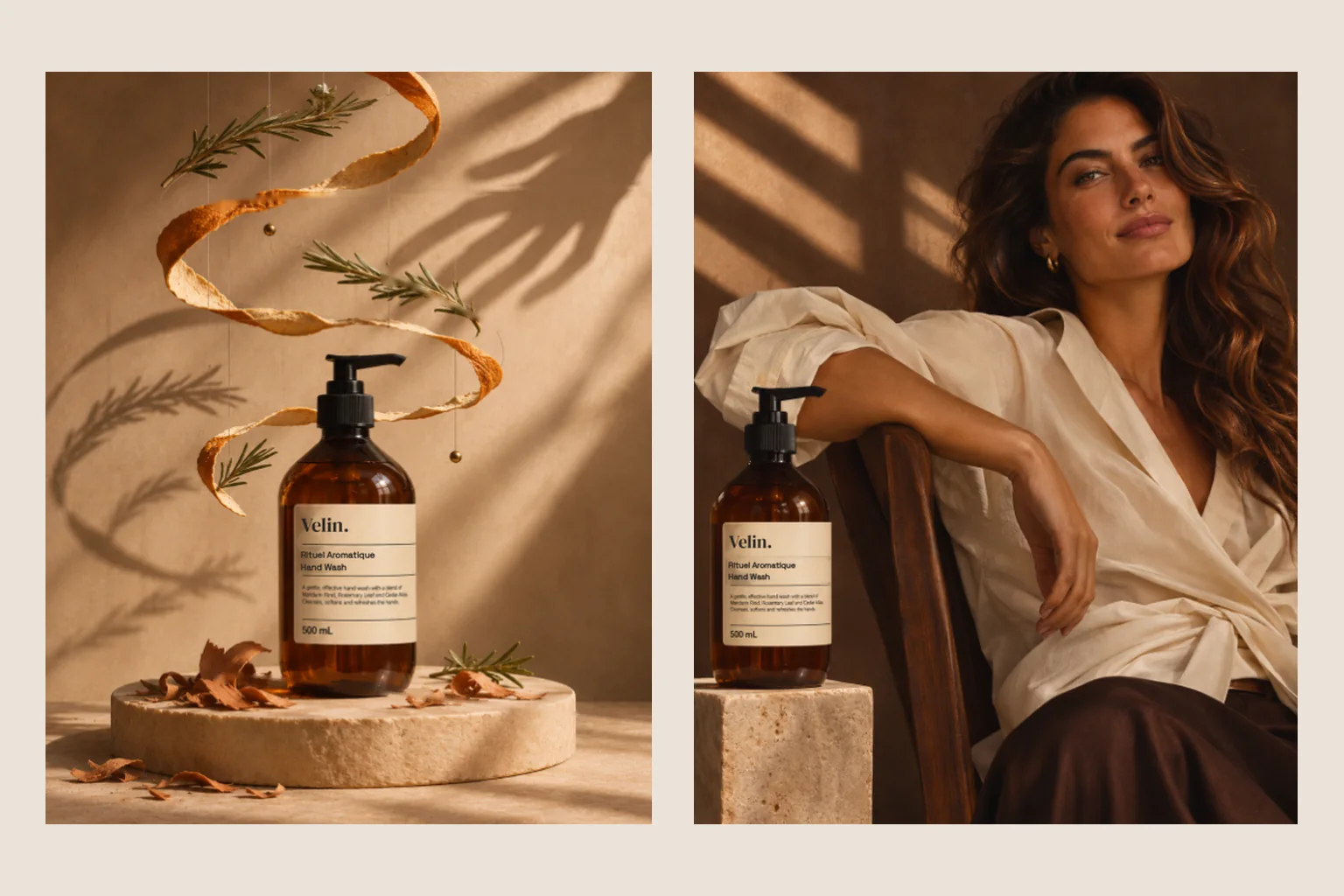
The idea grew out of the quiet imagery of Aesop. On our website we show the images with an invented label, Velin. The brief fitted on a note: a hand wash in an amber bottle, a ritual rather than a routine. Mood: warm stone, slow light, amber glass. Plus three ingredients you should almost be able to smell: mandarin rind, rosemary and cedar.
That became ten frames with a single bottle. The ingredients spiral around the product. A miniature bathhouse built around the bottle. Water, stone and foam for a thirty-second pause. A model who carries the mood, and finally a poster at a bus stop to show how the campaign works out in the world. Ten frames, one bottle, zero shoots.
Example 2: a day in Paris on two wheels
For the second study we imagined a collaboration that does not exist: Loewe meets Vespa. The campaign tells one day in seven stops, from packing at nine to golden hour by the Seine. In between: a ride down the boulevard, details like leather grips and a key knot, the long way round, a shop window and a poster on a wall.
The colour story holds everything together: cognac leather, cream, a pale blue silk scarf and, naturally, an iced matcha. Eight pieces, one colour world, the same model in every frame. That consistency is what separates a campaign from a collection of pretty pictures.
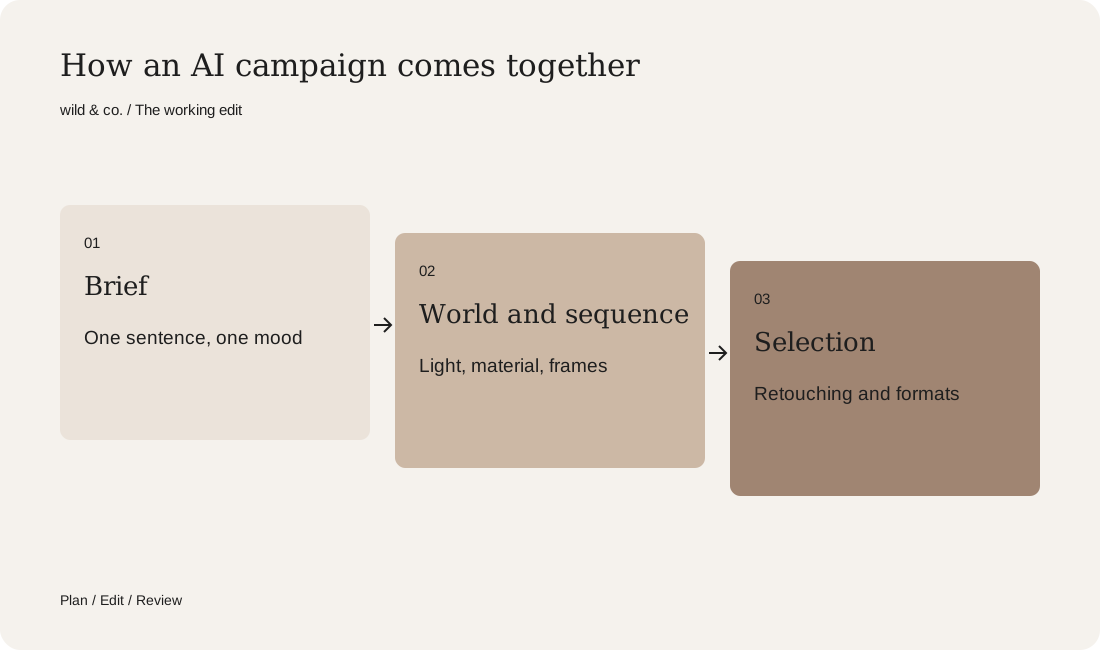
How we build an AI campaign
Independent study or client brief, the process is the same. The prompt is only one tool among many.
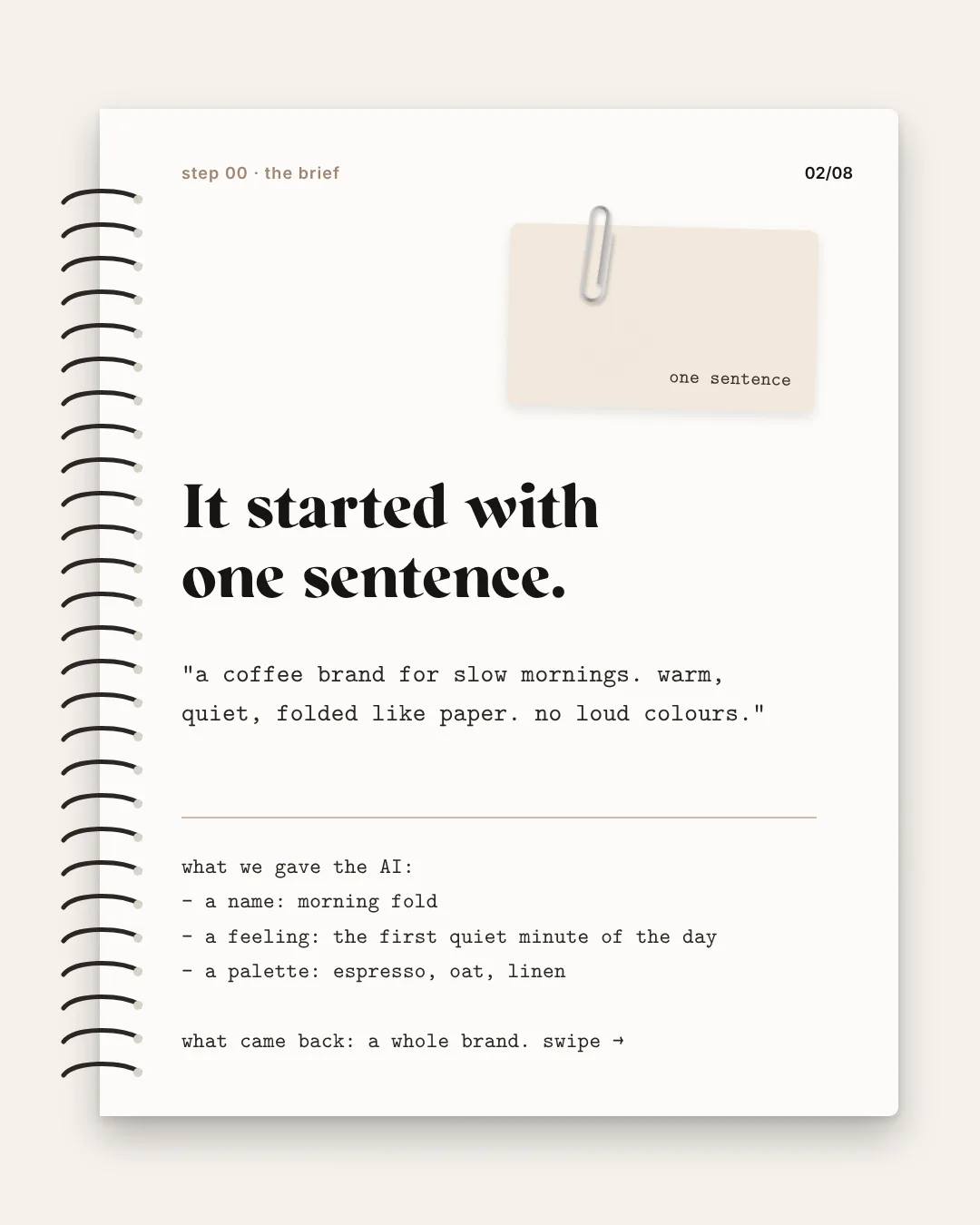
- A one-sentence brief: what is the product, and which feeling should stay?
- Define the world: light, materials, colours and places before the first image.
- Plan the sequence: which frames tell the story, and in which order?
- Stay consistent: the same face, product and light in every image.
- Edit hard: we discard far more than we show and refine the winners.
- Think in formats: feed, story, poster and website need different crops.
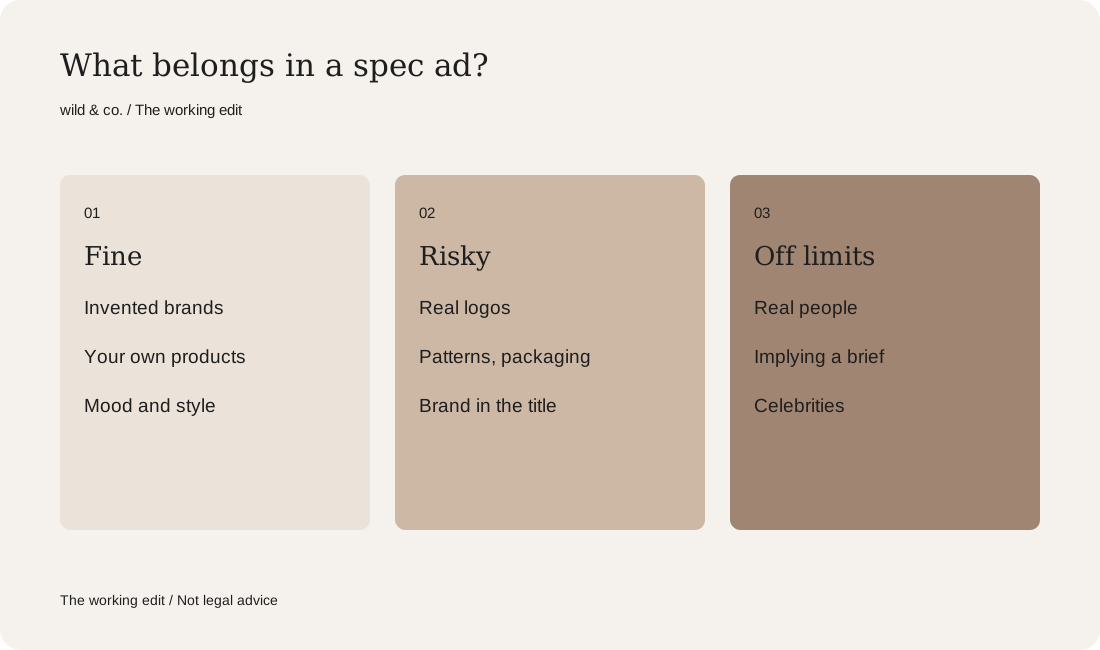
What is fine and what gets risky
We are not lawyers, and this section is not legal advice. A few principles help avoid trouble, though. Naming a brand in text to describe an inspiration is usually unproblematic. It gets risky when real logos, protected patterns or recognisable packaging appear in your own advertising. You are then leaning on another brand's reputation, which can have trade mark and unfair competition consequences.
- Label spec ads clearly as independent, uncommissioned studies.
- Never imply that a brand hired you.
- Do not show real people or celebrities.
- Use invented names and labels on your website, as we did with Velin.
- For campaigns with real brands: if in doubt, get professional advice first.
That is why campaigns with real logos only appear on our Instagram, clearly labelled. Our portfolio shows invented brands only, such as Minuit, Morning Fold or Pool Theory.
What you can take away for your own brand
The most exciting part starts when your own brand takes centre stage instead of someone else's. The questions around other people's logos disappear, and the same method works for you. One packshot becomes a campaign world. A sale idea can be tested before anything is printed. And an AI model can give your brand a recognisable face for months.
We always agree up front which details must be exact: your product's label, shape, colour and material. AI is fast, but it likes to invent things. Our job is to stop it doing exactly that. See how we create AI imagery and AI video for your brand, or start with the basics in our guide to AI images for business.