How does a logo project work, what drives the cost and which files and rights should you receive? Includes a template for your brief.
First decide whether you need a logo or a full brand identity. Ask about concepts, feedback rounds, variations, formats and rights, and bring a short brief to the conversation.
You need a logo. Perhaps you are just starting out, or perhaps the mark you put together yourself years ago no longer keeps up. Before you ask for a quote, it helps to know how a logo project runs, what drives the fee and what you should actually receive at the end. Then you know which questions to ask.
Logo or full branding: which do you need?
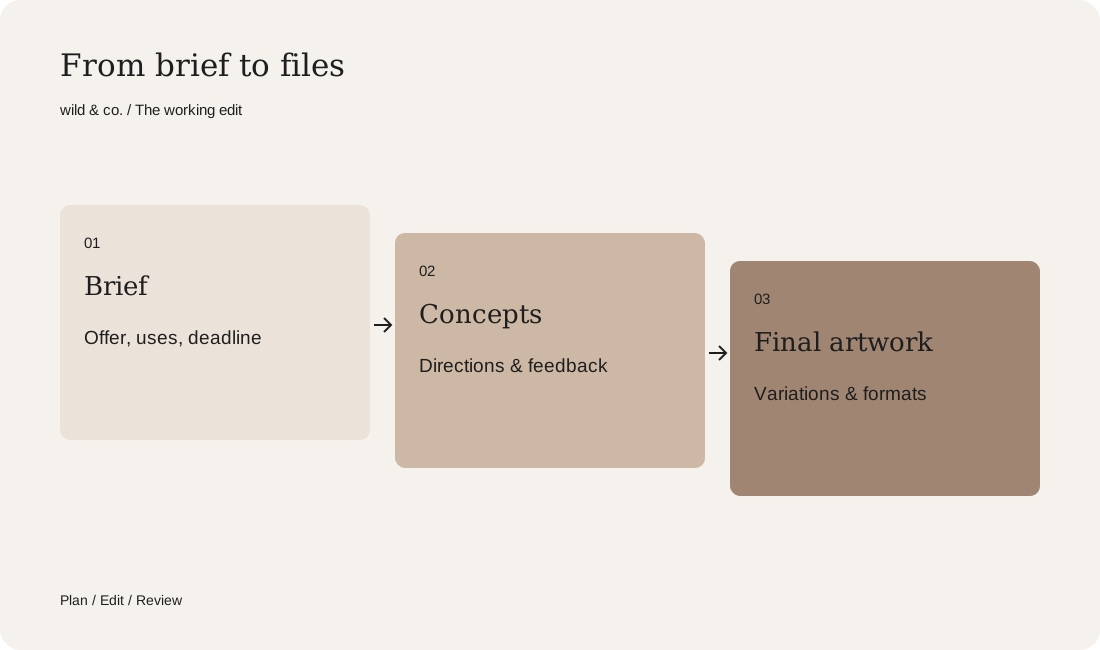
A logo is the mark people recognise you by. A corporate design adds colours, typefaces and layouts around it. Branding goes further still: what you stand for, who you serve and how you sound. If your offer is clear and you mainly need a well-made mark, a logo project is often enough. If you are not yet sure who you want to reach, a logo rests on shaky ground. In that case, clarify the direction first.
Having a logo designed: how the process works
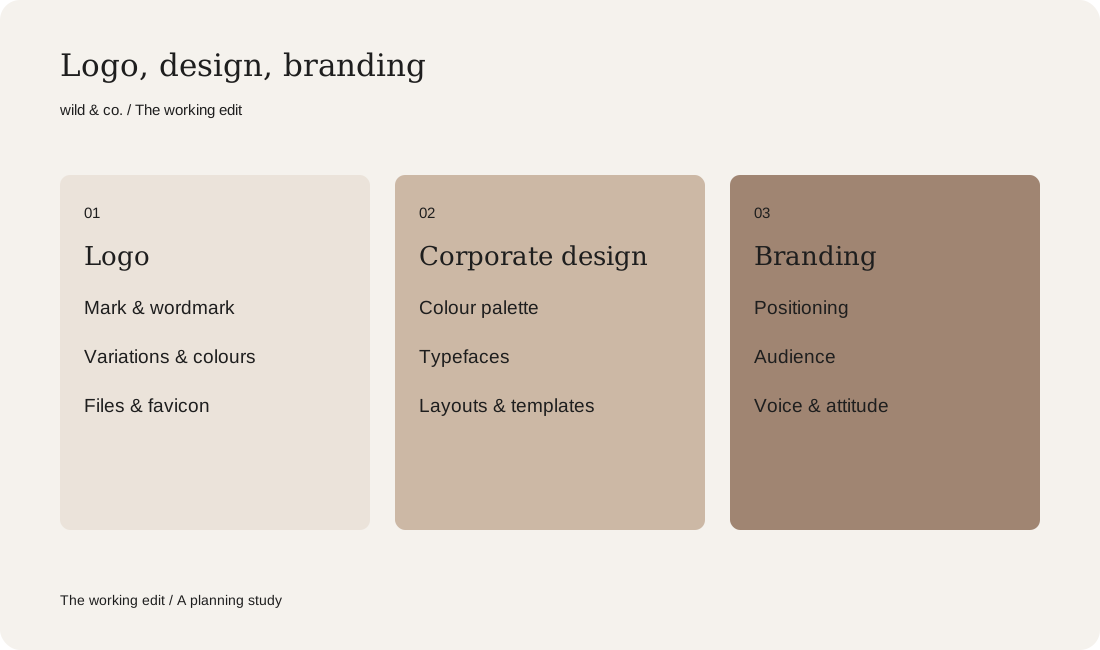
It starts with a brief. You explain what you do, for whom, and where the logo will appear. The designer then develops one or more design directions. You give feedback, one direction is chosen and refined. Finally, the logo is finalised: spacing, line weights and small sizes are checked before every file is exported. Ask in advance how many directions and feedback rounds are included. It sets clear expectations on both sides.
Your logo brief
What does a logo cost?
A reliable figure only exists once the scope is clear. Prices vary widely because the word «logo» can cover very different amounts of work. These factors shape the effort most:
- Groundwork: is there a conversation, some research or a moodboard?
- Concepts: how many directions are shown and how many rounds of refinement?
- Type of logo: a wordmark is built differently from a drawn symbol.
- Variations: do you need landscape and stacked versions, a short mark, a favicon?
- Typeface: is a font licence needed, or is the lettering customised?
- Handover: files only, or a short guide on how to use them?
When comparing two quotes, keep this list beside them. For breaking down a complete branding budget, read our guide to branding costs in Switzerland.
What you receive: variations, file formats and guidelines
A logo is more than one file. You need variations for different places: a primary version, a compact version for small spaces and usually a profile image for social media. Then colour versions: full colour, black, and white for dark backgrounds. For formats, SVG is the web standard because it scales as a vector without losing quality. PDF suits printers, and PNG with a transparent background works for presentations and office documents. Print usually needs CMYK values, screens RGB or HEX. A favicon for the browser tab belongs in the package too, along with a short guideline sheet: minimum size, clear space, colour values and what to avoid.
Usage rights and trade mark checks
Agree in writing which rights you receive. Can you use the logo without limits on time and territory? May you adapt it later or have someone else develop it further? Do you receive the editable working files? These points belong in the proposal or contract. Secondly, a logo is not automatically a protected trade mark. You can search the registers of the Swiss Federal Institute of Intellectual Property for similar marks. For a reliable assessment or an application, it is best to consult a specialist.
Logo generator, AI tool or a designed logo?
Online generators and AI tools produce ideas within minutes. That can be useful for a first impression, a side project or working out what you like. The differences lie in the detail. Generators often rely on templates and icons that others use too. AI images are usually raster graphics that must be rebuilt as clean vectors. Your rights to the result depend on each tool's terms, and a generated mark may resemble existing trade marks. With logo design by a person, someone also asks what the mark needs to do and tests it in your real applications. It is less a question of good or bad than of what you need.
How to brief a logo designer
A useful brief can be short. Write down what you offer and to whom. Name three qualities people should sense and one that would be wrong. List where the logo will appear: website, Instagram, shop window, stamp, van. Collect two or three examples you like and say why. Add your deadline and budget range. An invented example: «I'm opening a cycling café in Winterthur. Cosy, hands-on, not trendy. The logo has to work on the sign, on cups and on Instagram.» At wild & co., this is exactly the kind of brief we begin with. Note your answers in the planner on this page and your brief is ready.