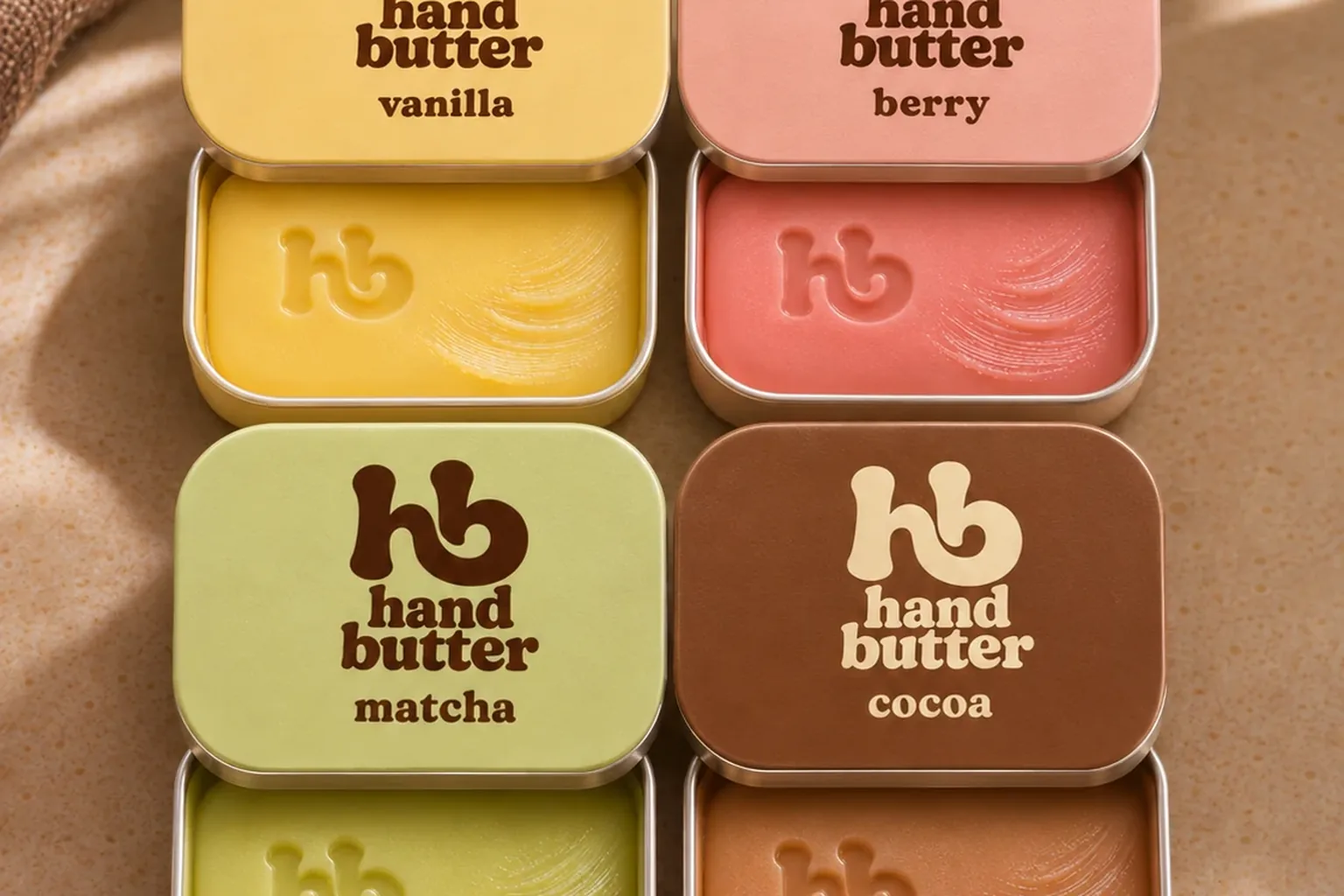
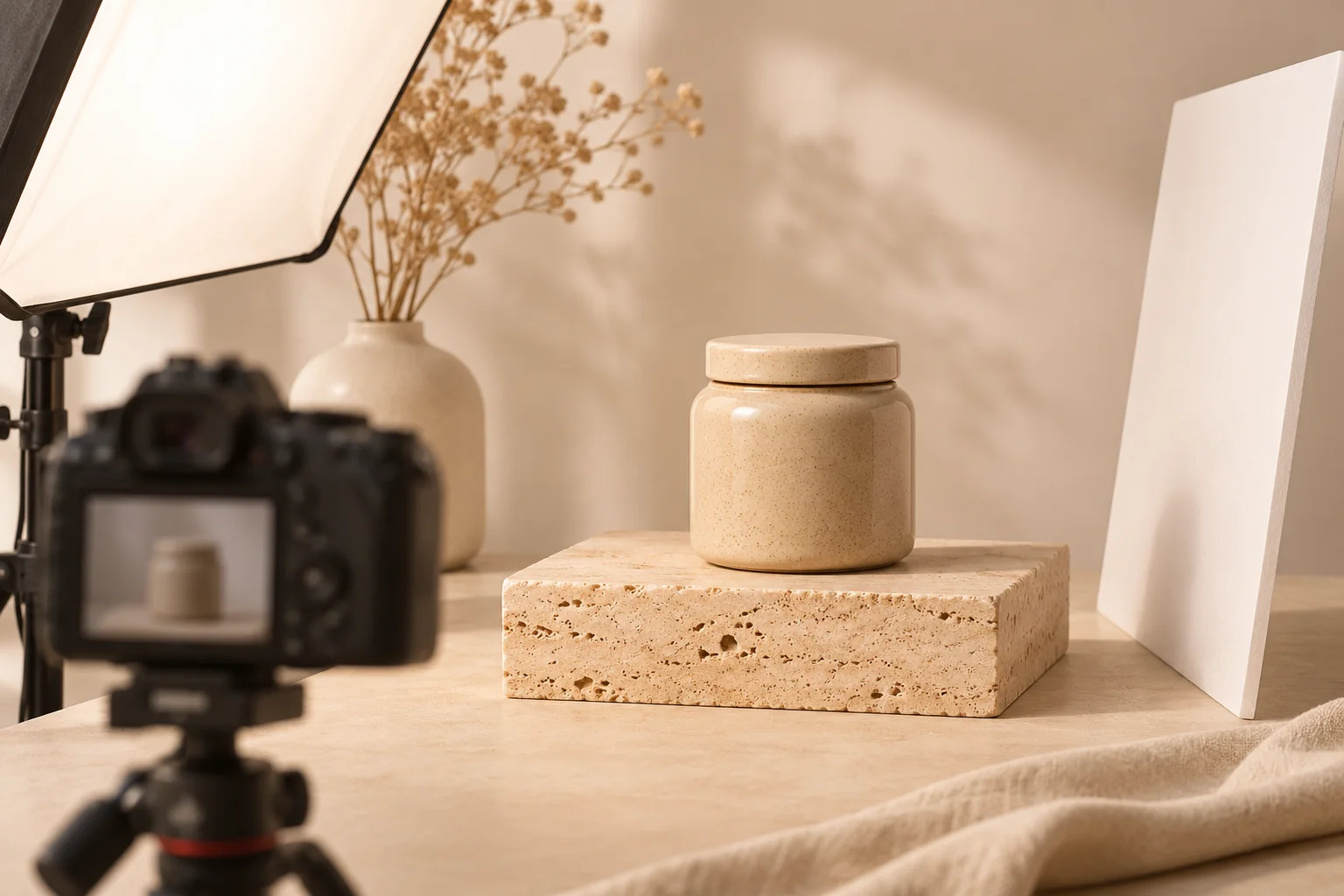
A hand wash is not an exciting product. Pump, lather, done. Yet some brands manage to turn it into a moment people look forward to. Here is how to stage a product as a ritual, with still life, ingredients, hands and a clever play with scale.
Ritual staging shows not just the product but the moment it is used and the feeling afterwards. Translate scent and texture into visible carriers such as ingredients, stone, lather and light. Stick to a few still life rules, play with scale, show hands and people as mood, and tell the images as a sequence.
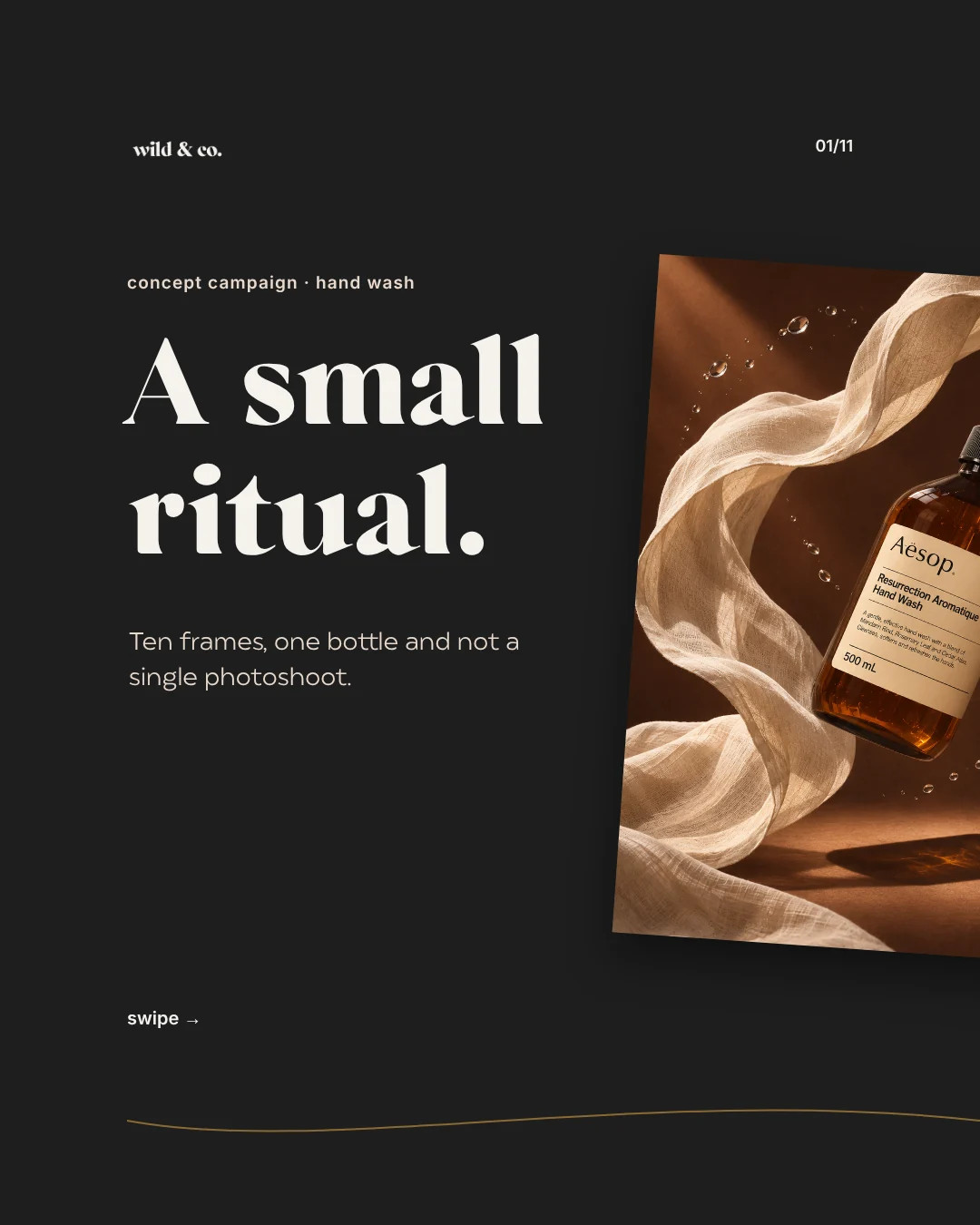
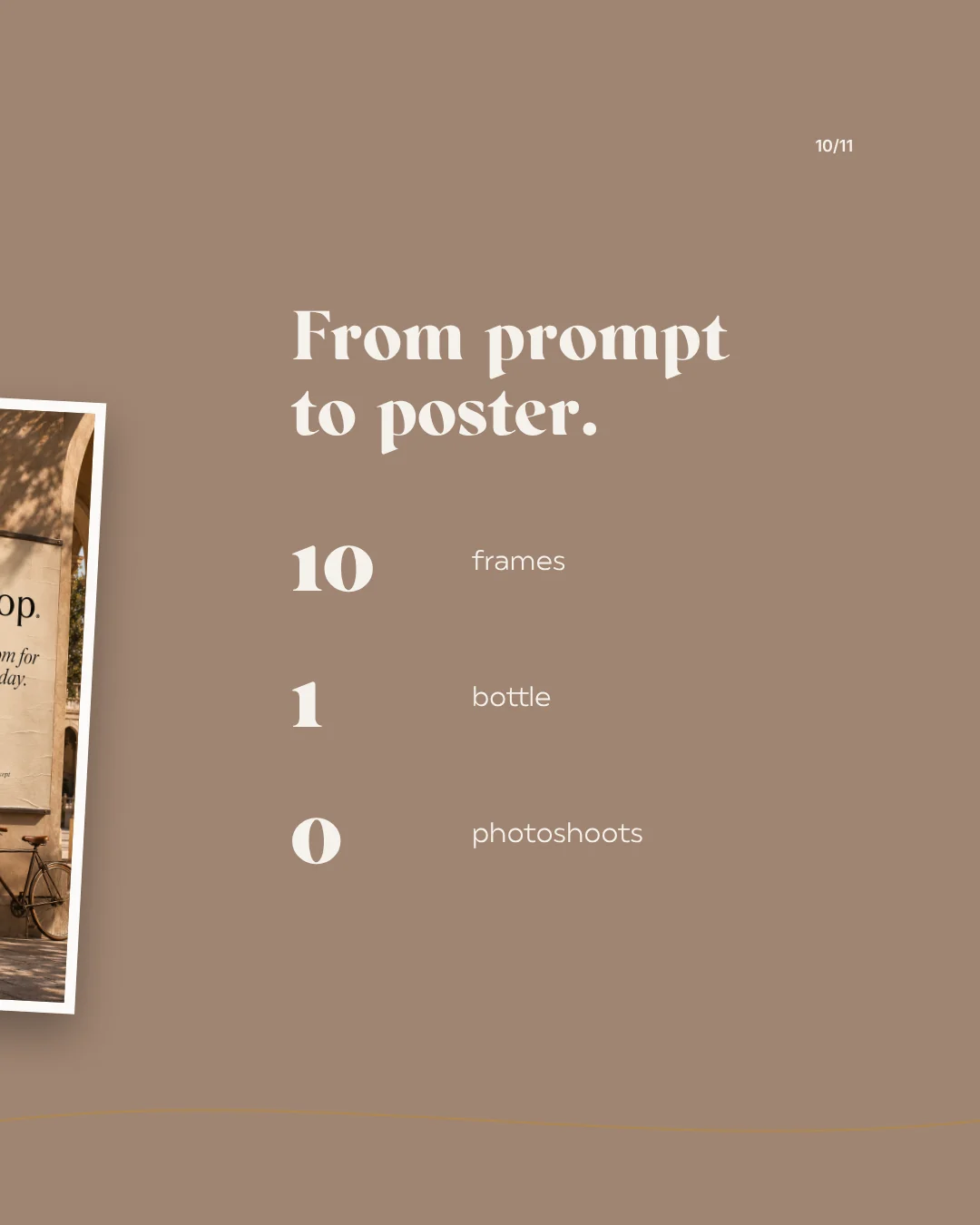
Some products explain themselves. Others need a stage before you understand why they are more than their contents. Care products nearly always belong to the second group. For an Aesop hand wash we developed a campaign called ‘A small ritual’: ten images, one bottle, no photoshoot. It is an unofficial concept study, not affiliated with or commissioned by the brand. Every image was made with AI. Trademarks belong to their respective owners. We briefly tell how the study came about in our guide to spec ads with AI. This guide is about the craft behind it: how does a still life become a ritual?
What product staging means
Staging means deciding where, how, with what and in which light a product appears. A packshot shows what something looks like. Staging shows how it feels. Ritual storytelling goes one step further: it shows the small, recurring moment in which the product is used, and lifts it out of the everyday. It works especially well for things people pick up every day: soap, cream, tea, candles, a fragrance, a bowl of matcha in the morning.
The guiding question: ritual, not routine
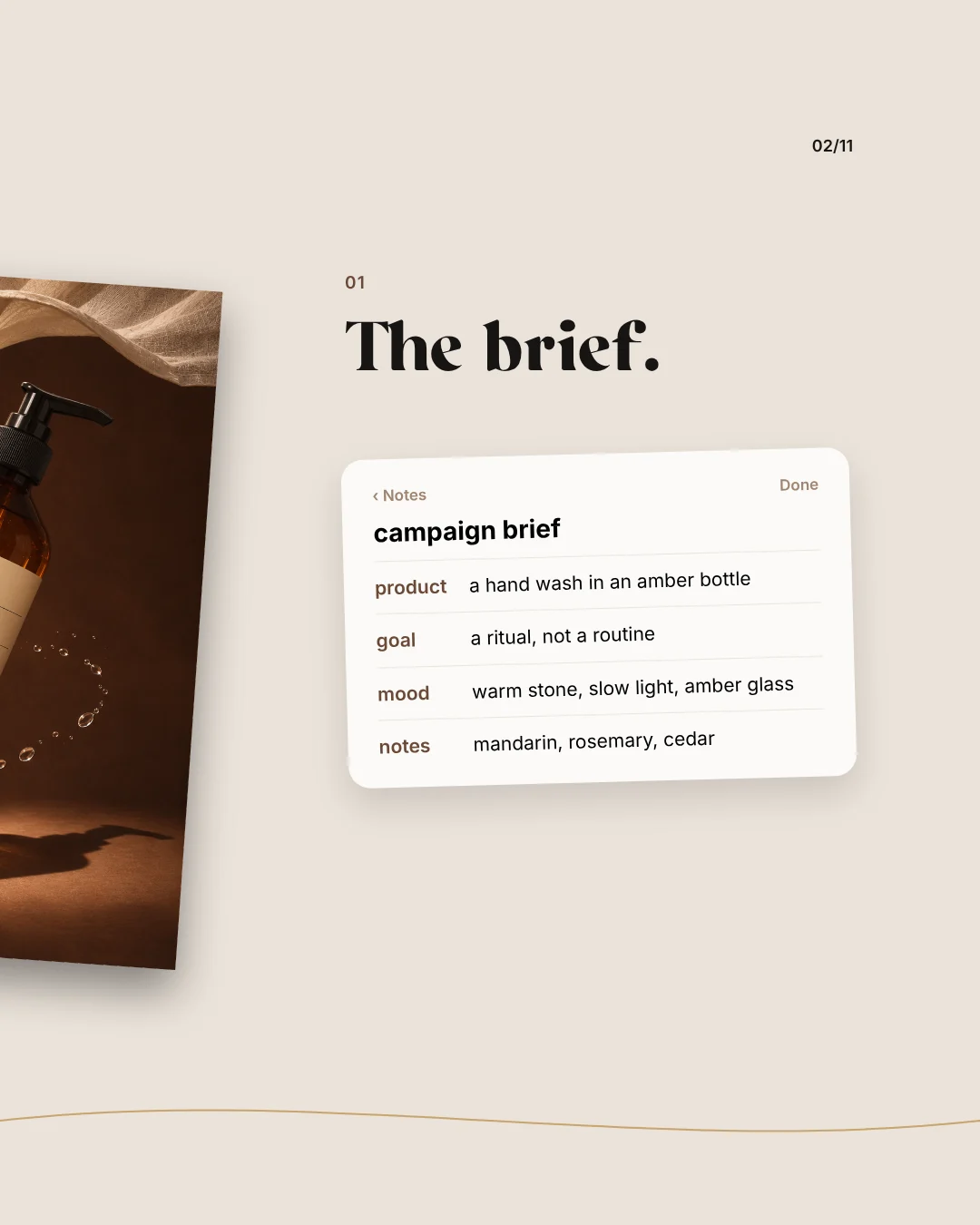
Our brief fitted on a four-line note. Product: a hand wash in an amber bottle. Goal: a ritual, not a routine. Mood: warm stone, slow light, amber glass. Notes: mandarin, rosemary, cedar. The second line matters most. It becomes the guiding question for every image idea: does this picture slow things down, or is it merely pretty? An image that feels rushed is out, however well made. Write a similar contrast for your own product, such as pause rather than chore, or pleasure rather than habit.
Your ritual script
Translating the senses: making scent and texture visible
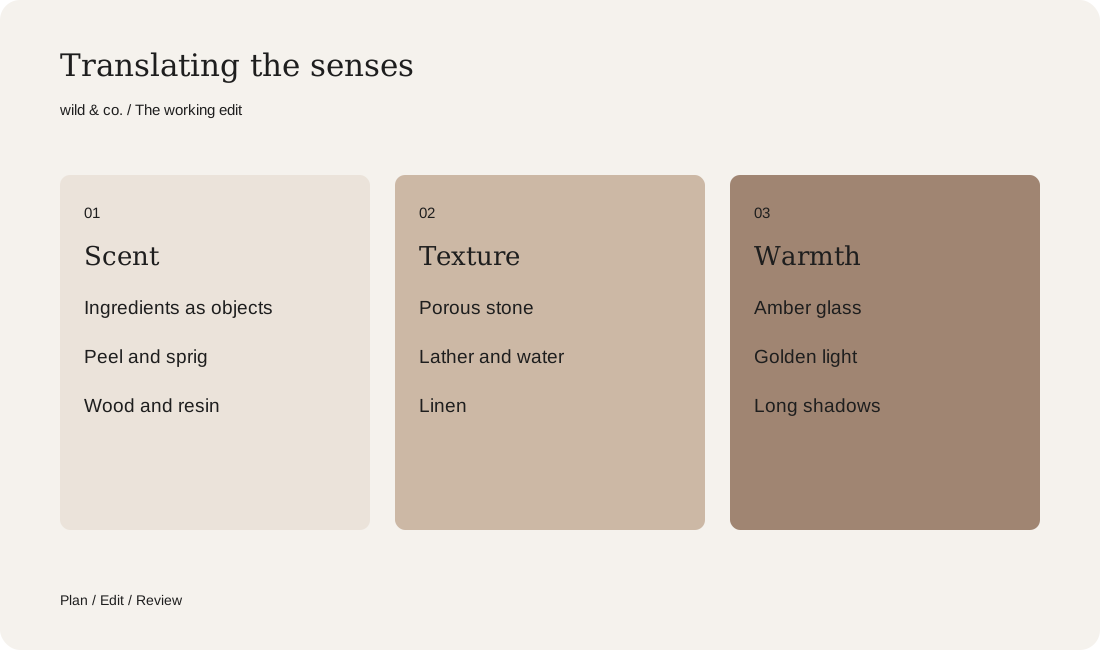
You cannot smell a photograph. You can, however, show what something smells of and how it feels. The trick is to give each sense one visible carrier, one rather than five:
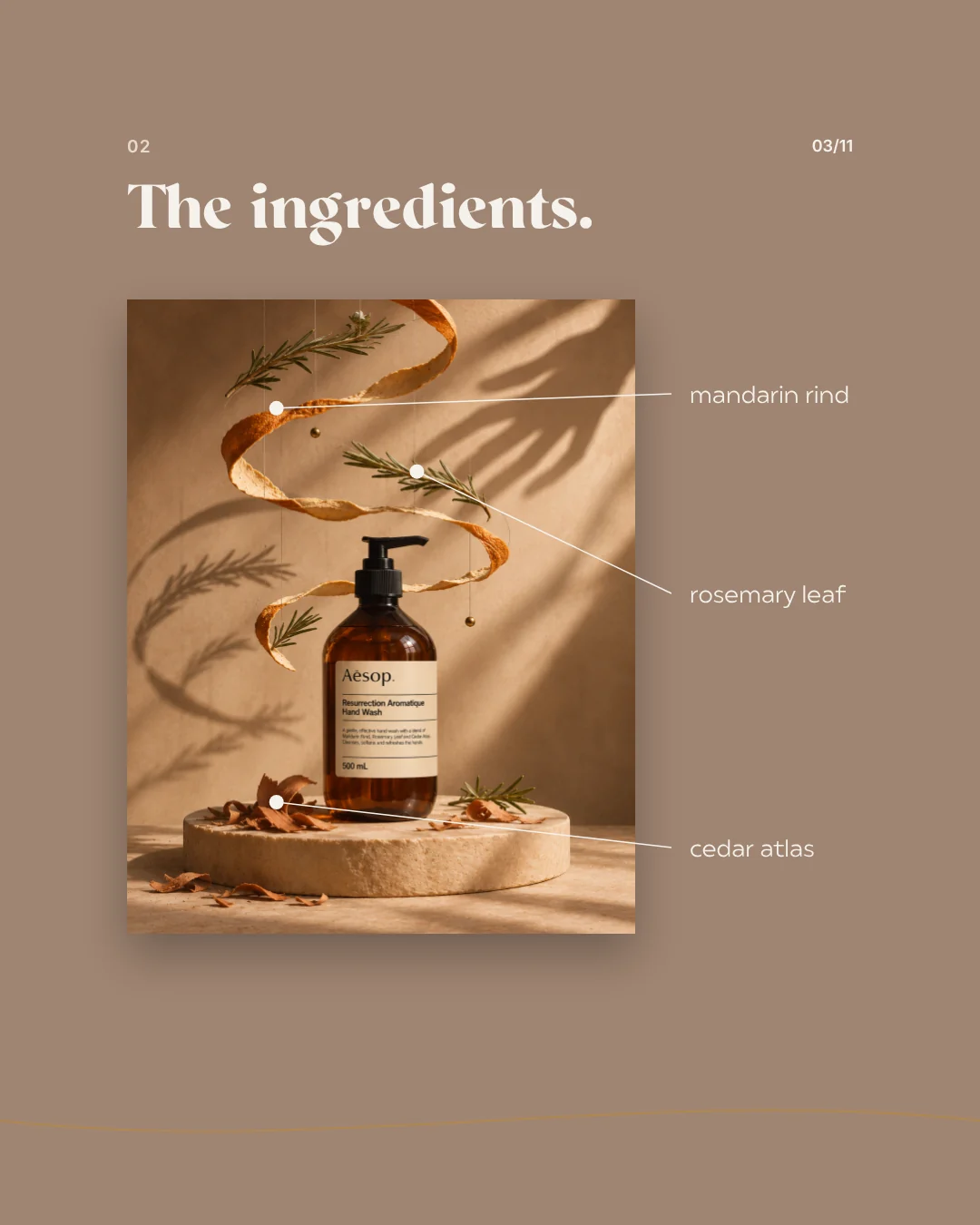
- Scent: ingredients as objects. In our study a mandarin peel spirals around the bottle, with a sprig of rosemary and cedar wood.
- Texture: surfaces with pores and grain, such as travertine, lather, water and linen.
- Warmth: amber glass and golden side light instead of cool studio white.
- Calm: plenty of empty space and water that is just settling.
- Time: long leaf shadows that show the sun is low.
Still life rules for calm images
A calm image is rarely empty. It is carefully reduced. These rules have served us well, in the studio and with AI alike:
- One hero per image. The product shares the stage with one ingredient at most.
- Props from the same world: stone, wood, linen, glass. Nothing that looks as if it came from a different catalogue.
- Light from one direction, so shadows become part of the design.
- A surface with character, such as porous stone rather than smooth plastic.
- Leave space, so there is room for a line of text on a poster or post later.
- No decoration that tells nothing. Every object needs a reason to be there.
Scale and world: build small, feel big
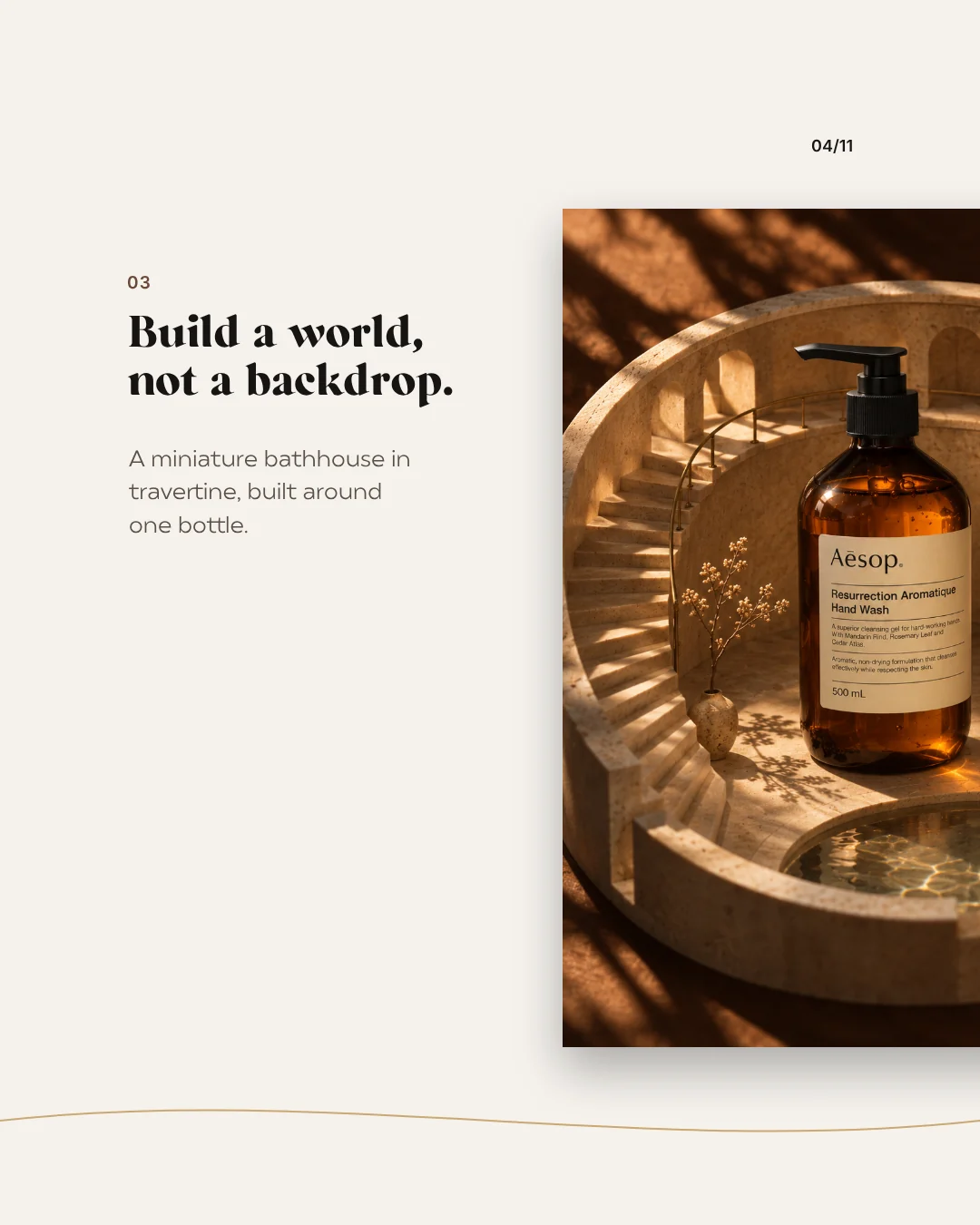
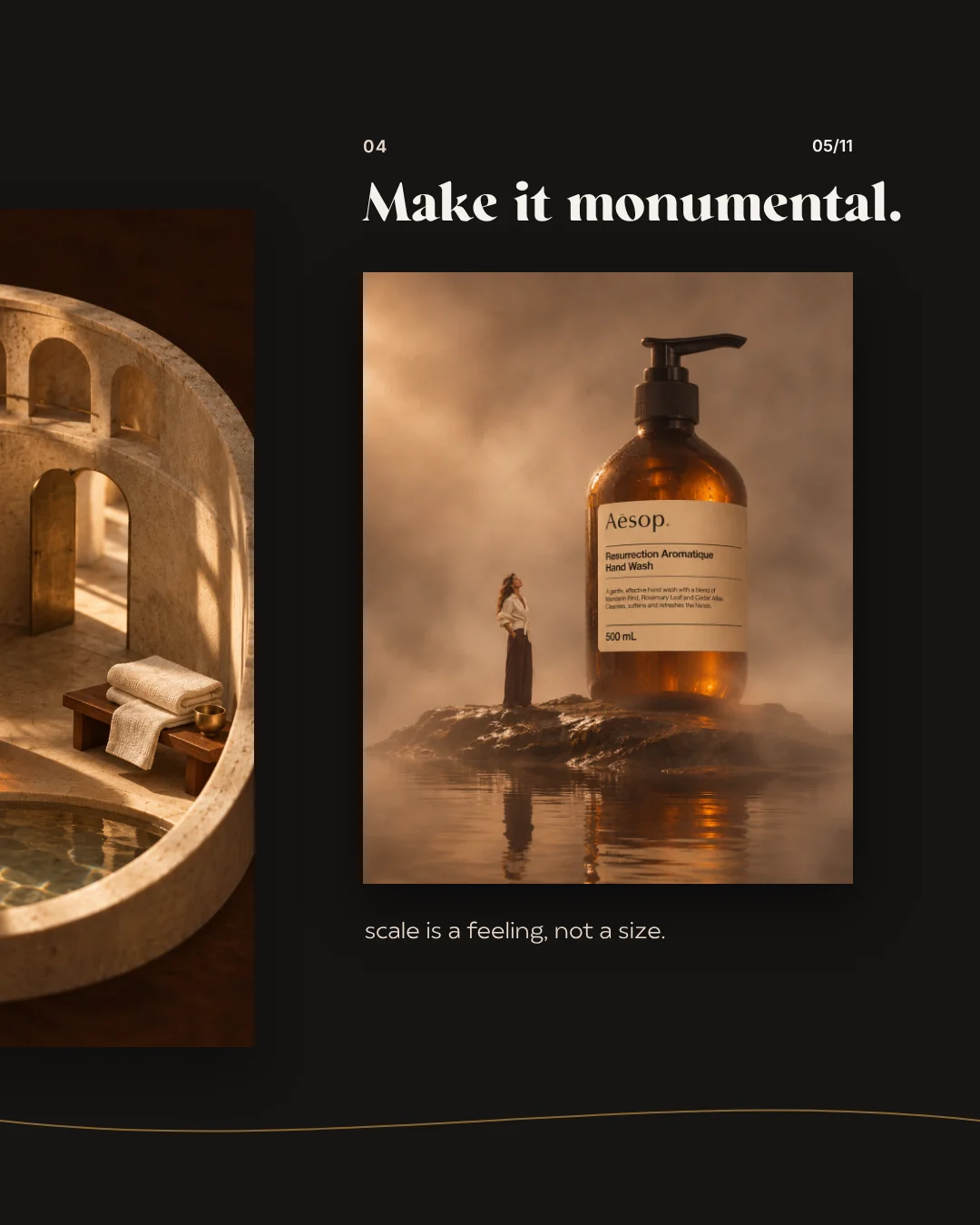
An everyday object becomes special the moment you shift its scale. In our study the bottle stands in a tiny travertine bathhouse built around it, with steps, arches and a pool. In another image it rises from the mist like a lighthouse, with a tiny figure in front of it. The slide puts it simply: ‘scale is a feeling, not a size’. With AI such worlds can be built relatively quickly. A real shoot needs model-making or a set, which takes effort but is perfectly doable.
Hands, people and feeling
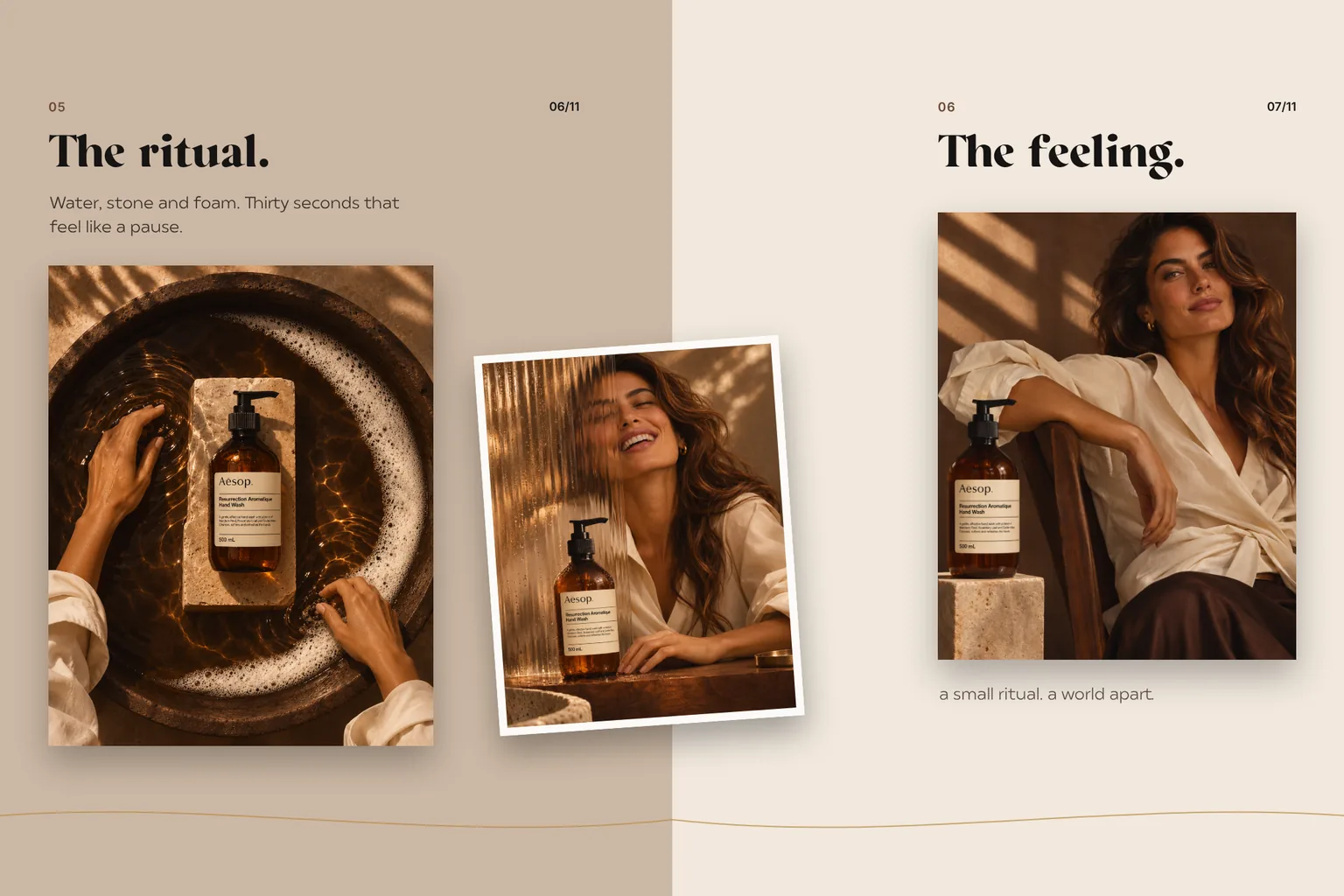
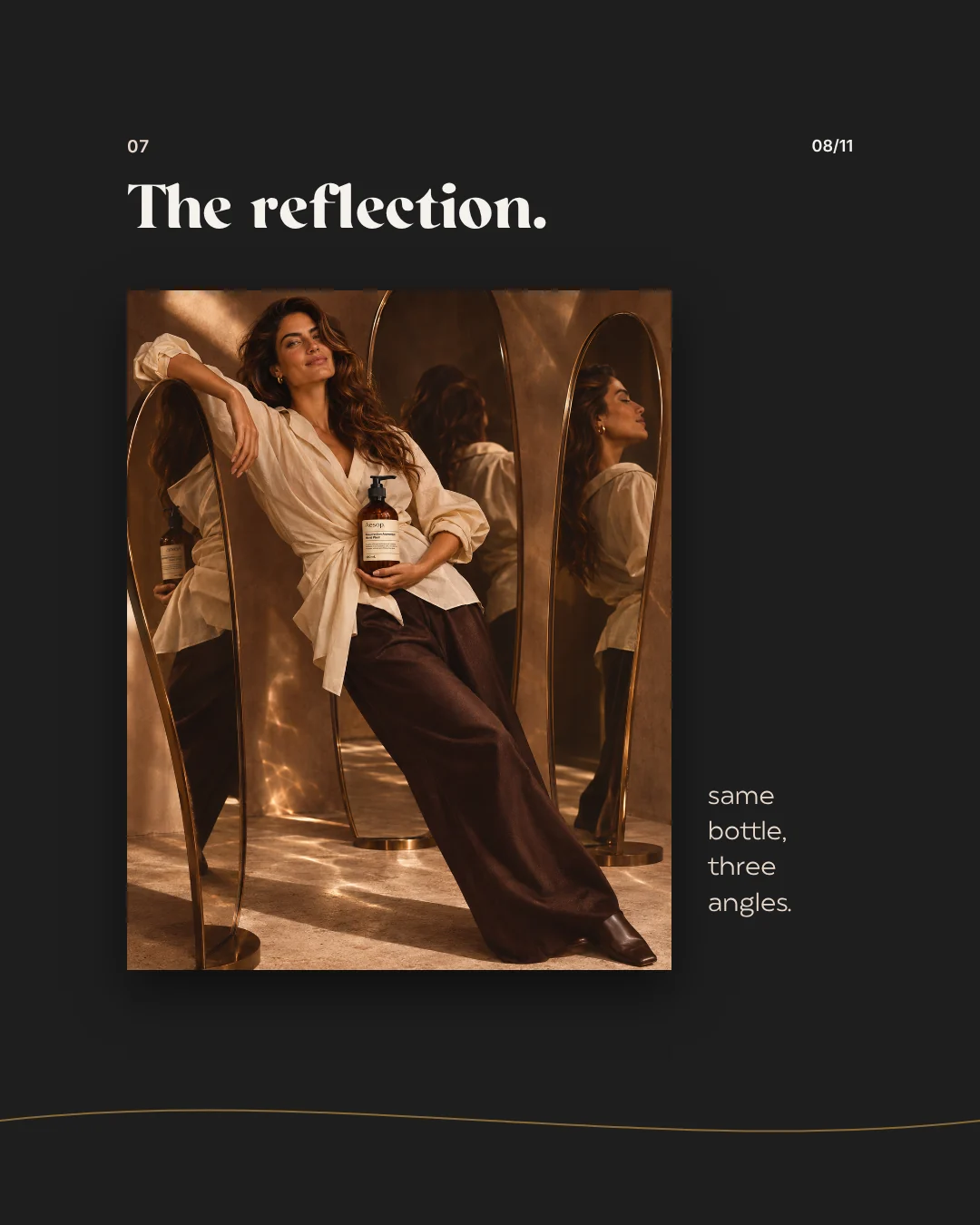
Hands are the most direct way to show a ritual. In our campaign the bottle rests on a stone in a bowl of water and lather while two hands move around it. Nothing more is needed to say: someone is taking thirty seconds for themselves. When a person enters the frame, they should carry the mood rather than hold the product up to the camera like a TV advert. The bottle stands beside her on a stone plinth while she looks calmly into the light. Mirrors double the scene and show the same bottle from three angles, which quietly strengthens recognition.
The sequence: from object to street
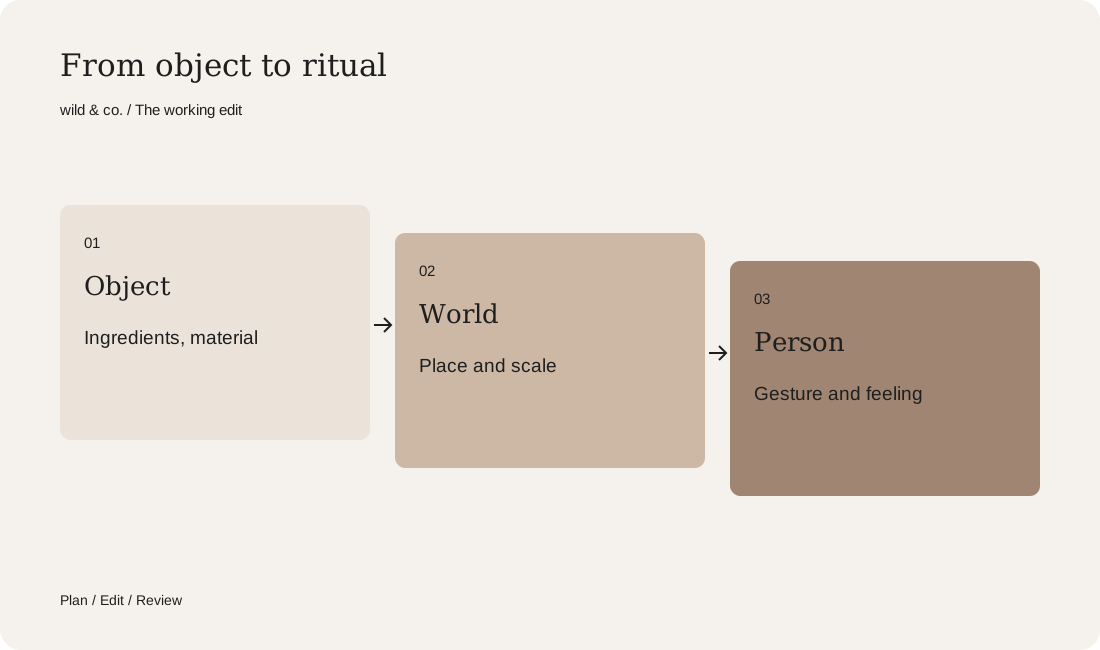
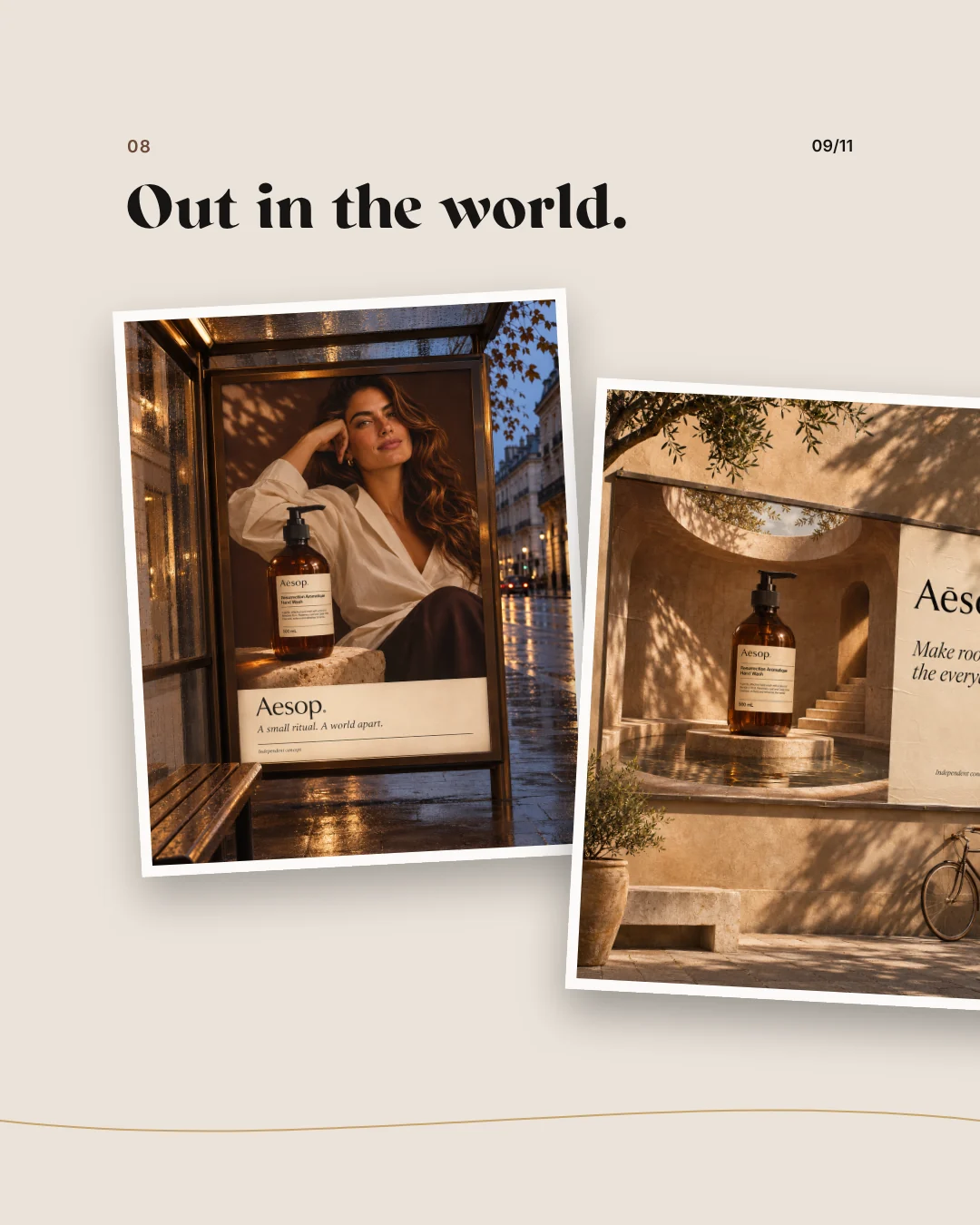
Ten beautiful images are not yet a story. The order makes the difference. Our campaign opens with the brief, then shows the ingredients, builds the world, makes it monumental, moves to the ritual with the hands, to the feeling and the reflection, and ends outside in the city, at a bus stop and on a poster. From object to world, from world to person, from person to street. That last step is a good test for any staging: does the image still work as a poster, with one line of text, seen from five metres away?
Photoshoot or AI?
Both have their place. A real shoot is the better choice when the product has to be exact down to the detail: label, pump, colour of the glass, the texture of the soap. AI comes into its own with worlds that are hard to build or film, such as miniatures, mist, floating ingredients and places that do not exist. Often a combination is ideal: a real packshot with an AI world around it. Our guide to skincare and beauty product imagery covers the other image types care brands need. For an invented care brand with an evening ritual, see our AI campaign hand butter.
Planning your own product staging
With the script above you can decide in a few minutes which ritual your product tells and which images you need for it. At wild & co. in Zurich we plan product photography, video and AI worlds for brands across Switzerland, in person or remotely. To see how we stage whole brands with AI, visit the wild lab, where every study carries an invented name.